




6 min read
Still Managing Everything In-House? Why Universities Are Rethinking IT Operations


The Growing Pressure on University IT Teams
IT environments in higher education differ from those in many other sectors.
Universities run intricate ecosystems that require the smooth operation of numerous systems. Throughout the academic year, communication systems, learning platforms, administrative tools, and student information systems must all operate dependably.
Simultaneously, and frequently without additional resources, IT teams must handle increased cybersecurity concerns, rising demands for digital services, teacher and student support needs, system maintenance and upgrades, and data privacy and compliance regulations.
As a result, the IT department frequently concentrates on maintaining current systems rather than investigating novel ways that technology may enhance instruction, learning, and campus operations.
This is not a problem brought on by inexperience. It's a scale issue. Prioritizing major projects can soon become challenging when internal teams are in charge of every operational element. Consider an IT team that has been working on a SIS upgrade for the past two semesters, but they are unable to proceed since everyday support requests take up all of their available time. There is a project. There is an obvious necessity. It just doesn't have the capacity.
What Managed IT Services Mean for Higher Education
Universities can collaborate with technology experts who continuously support particular IT functions through managed IT services. Infrastructure monitoring, cybersecurity assistance, LMS and SIS administration, system updates, technical troubleshooting, and end-user support are a few examples of these.
Managed services function as an extension of the university's internal IT department, in contrast to traditional outsourcing. Removing institutional control is not the aim. The objective is to give colleges more knowledge, resources, and assistance where they most need it.
Internal IT staff can concentrate on enhancing digital offerings, streamlining workflows, and advancing more general university objectives rather than devoting hours to fixing persistent platform problems. Think about a university where regular LMS maintenance takes up the majority of the workweek for IT professionals. When that layer is handled by a managed services partner, those same employees can focus on creating integrations that genuinely enhance the student experience.

Where Managed Services Create the Most Impact
Cybersecurity Monitoring and Response
Large volumes of sensitive data, such as student records, financial information, and research materials, are managed by universities. Because of this, cybersecurity is of utmost importance. Through ongoing monitoring, threat identification, and quicker reaction times, managed security services assist organizations in fortifying their defenses.
Universities can lower risks and free up internal teams to concentrate on other technology goals with specialized security help. Consider a university without after-hours surveillance. If a security issue starts late at night, it won't be discovered until the next morning, by which time serious harm has already been done. Risks are recognized and dealt with before they worsen thanks to managed cybersecurity support.
LMS and SIS Platform Support
Systems for student information and learning management are crucial to the day-to-day operations of universities. But these platforms need constant care, from upgrades and integrations to troubleshooting and performance tracking.
These systems are kept dependable and in line with institutional requirements thanks to managed service providers with experience in higher education technology. This enables IT teams to concentrate more on enhancing the ways in which platforms assist instructors and students rather than on platform maintenance. Think of a school where the internal team is too busy to schedule
Banner updates, which causes data inconsistencies that impact the accuracy of enrollment reporting and advice.
Helpdesk and User Support
Problems with technology don't always occur at convenient times. Before turning in assignments, students could experience access problems. Before instructing a class, faculty members sometimes want immediate support. During crucial academic times, administrators can need assistance.
Universities can provide a more seamless digital experience without constantly growing their internal workforce thanks to managed helpdesk services, which offer extra support capacity. If a faculty member is unable to access their course materials the night before a class, they can get help within an hour instead of having to wait until the following business day thanks to managed help desk support.
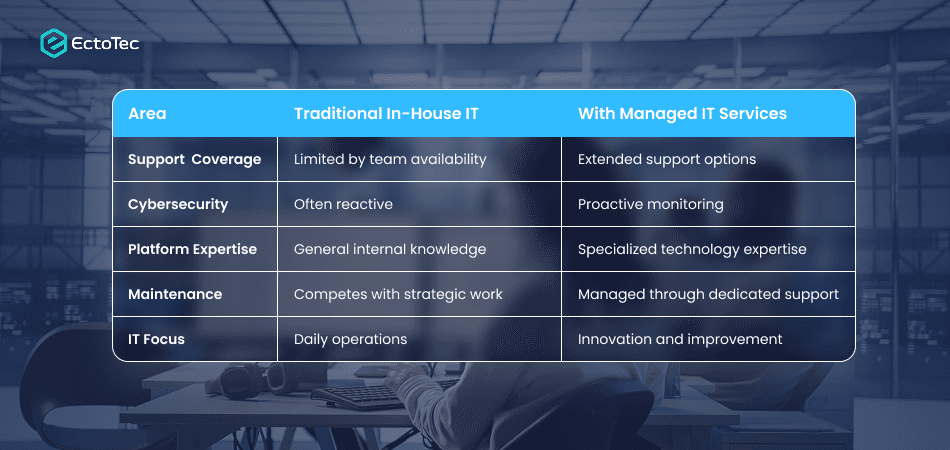
Managed Services vs. Traditional In-House IT
Adopting managed services helps universities strike a better balance between promoting digital transformation and preserving critical systems. The internal IT staff is still in charge, but they have more ability to plan, develop, and innovate.
Conclusion
Technology that is dependable, safe, and effective is essential to the future of higher education. However, putting new mechanisms in place alone won't be enough to achieve that vision. In order to sustain and advance those technologies over time, universities also require the proper support system.
Managed IT services enable organizations to move past ongoing troubleshooting and make room for significant digital transformation. Technology becomes more than just an operational necessity when IT personnel receive the assistance they require.
Enhancing experiences for teachers, students, and the campus community as a whole turns it into a strategic advantage.