




6 min read
Beyond Spreadsheets: How Business Intelligence Is Reshaping University Decisions


Introduction
Spreadsheets have long served as the foundation for institutional reporting in higher education.Academic departments monitor retention in files that hardly ever communicate with one another, registrars export enrollment statistics into Excel, and finance teams create budget models in separate spreadsheets. Until it doesn't, it functions.
Spreadsheet-based reporting begins to fail as institutions become more complicated, with more programs, campuses, and systems. Reports take days to prepare, numbers become out of sync,and by the time a dashboard is manually constructed, the underlying data is already out of date.
This is being altered by business intelligence (BI). Instead of static files that expire the moment they are exported, BI provides university administrators with current dashboards and dependable reporting by integrating data from the SIS, LMS, CRM, and financial systems into a single analytics layer. The change affects decision-making at all levels of the organization and is not merely technical.

Why Spreadsheets Struggle at Institutional Scale
Spreadsheets were never intended to serve as a record-keeping mechanism for an organization.They function effectively when one analyst is responding to a single query, but they fall apart when several departments require the same data.
In higher education, there are a few recurring trends. Because each team pulls and modifies data independently, enrollment statistics from the registrar's office frequently don't match the version used by finance. Creating a single report may require exporting the data from the SIS, manually cleaning it, and reformatting it in Excel. This procedure might take days and must be repeated each reporting cycle. Enrollment or financial circumstances may have altered by the time a spreadsheet report reaches leadership. Additionally, spreadsheets can display events, but they rarely make it simple to investigate the reasons behind them or simulate potential future events.
These problems have nothing to do with effort. IT teams, registrars, and analysts frequently put forth a lot of effort to maintain spreadsheets' accuracy. The issue is structural: the volume of data at a modern university just cannot be handled by manual, compartmentalized reporting.
What Business Intelligence Actually Changes
In higher education, identity management is not a single tool that is added to already-existing systems. Identity, authentication, authorization, access, lifecycle, and governance are all combined into one cohesive chain by this architecture. It creates an individual's identification, confirms it when they log in, determines what they are allowed to do, allows that access, updates it when their role changes, and monitors the entire process.
One of the most obvious features of that system is single sign-on (SSO), which allows a user to authenticate once and move between the SIS, LMS, email, and other associated platforms without having to log in again for each. But SSO just handles authentication—that is, confirming that an individual is who they claim to be. What they should be able to accomplish once inside is not specified. Authorization, the layer where IAM gives permissions based on department, position, program, or employment status and maintains those permissions through automated provisioning and deprovisioning, is in charge of this.
At this stage, student authentication becomes crucial beyond the login screen. A well-designed IAM system determines whether a user is an active employee or student and what access their present function requires using authoritative data from the SIS or HR system. It does more than just confirm that a person is familiar with a password. When that status changes, access automatically adjusts without a help desk ticket. Instead of staying unchanged until someone remembers to manually update it, a student's access to department-specific resources is updated in unison with their academic record when they change majors in the midst of the semester.
Where IAM Creates the Most Impact
Business intelligence solutions use linked analytics in place of dispersed exporting. BI solutions pull data directly from the SIS, LMS, CRM, and financial platforms into dashboards that update automatically, eliminating the need to manually compile information from several systems.
There are several specific ways in which this transition affects institutional decision-making. Deans and provosts can access a dashboard that displays current enrollment, retention, or budget performance at any time, filtered by program, campus, or term, rather than having to wait for a monthly PDF. There are less disputes over whose report is accurate when academic affairs, finance, and admissions use the same linked data sources. Additionally, without submitting a data request and waiting for IT to react, department heads may use well-designed dashboards to answer their own queries, delving into a particular program or filtering by cohort.
Descriptive questions are the main application for traditional spreadsheets: How many students were enrolled last semester? How much was spent by a department? That capability is expanded on three levels by BI. Through dashboards that provide an overview of enrollment, retention, or spending, descriptive analysis demonstrates what transpired. By enabling leaders to delve into a measure and analyze it across programs, campuses, or terms, diagnostic analysis shows why it occurred. Additionally, trend analysis can be used to forecast demand, anticipate changes in enrollment, or identify budget disparities before they materialize.
This path, which lets leaders get from what happened to why it happened and, increasingly, what might happen next, is what sets BI apart from a digital spreadsheet.

What It Takes to Get There
Purchasing a dashboard tool is not the only step in implementing business intelligence.Businesses that use BI successfully usually build it on a few pillars:
Integration of trustworthy data comes first. BI projects rely on reliable connections between the SIS, LMS, CRM, and financial systems rather than manual uploads because dashboards are only as good as the data that powers them.
It is equally important to have clear data ownership. To ensure that all dashboards use the same terminology, someone must be responsible for defining what "enrolled," "retained," and "active" genuinely mean throughout the organization.
Dashboards are kept functional rather than overwhelming by role-based access. A financial analyst, a department chair, and a provost require distinct perspectives on the same underlying data rather than a single, complex report that tries to satisfy everyone.
Additionally, usability determines uptake. Even the most advanced analytics technology is useless if academic and administrative staff find it too complicated to utilize on a regular basis.
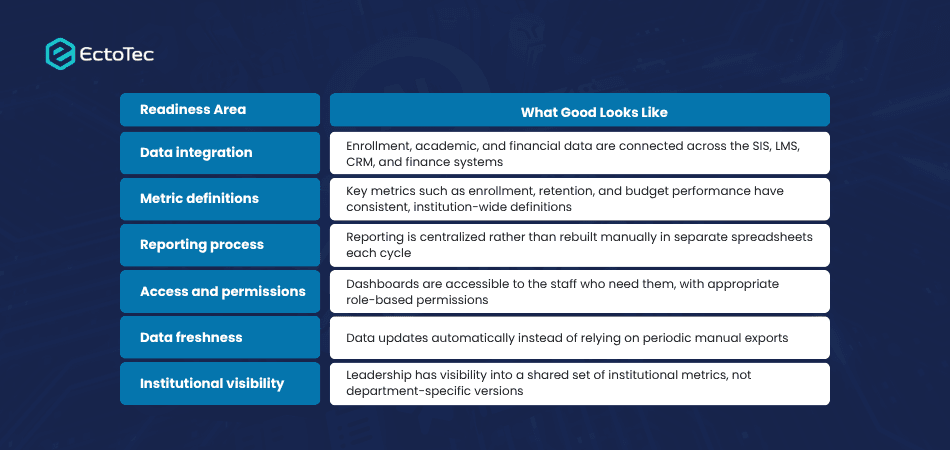
Higher Education BI Readiness Checklist
Before investing in a BI platform, it's worth reviewing how ready your institution's data and processes actually are:
Businesses are well-positioned to transition to contemporary BI if they can tick the majority of these boxes. Those that are unable to do so will probably have to start by filling the data integration and governance holes; otherwise, the dashboards would just show the same discrepancies that spreadsheets already had.
Building a Path Toward Institutional BI
The transition from spreadsheets to business intelligence occurs gradually rather than all at once for the majority of colleges.
In order to determine where the SIS, LMS, CRM, and finance systems already interact and where there are still gaps or manual workarounds, it usually begins with an evaluation of current reporting procedures and data sources.
In order to build dashboards on reliable, automatically updated data rather than manual exports, institutions then give priority to integrating the systems that feed the most important reports, which are typically enrollment and financial data.
The next step is dashboard design, which is based on the real queries that various roles require to be addressed rather than a screen reproduction of an existing spreadsheet. The purpose of BI is lost in a dashboard that merely digitizes an outdated report.
Lastly, governance defined metric ownership, established definitions, and a procedure for incorporating new data sources as the institution's requirements change—is necessary for sustainable BI.
Because the tools actually make people's jobs simpler, universities that consider BI as an ongoing capacity rather than a one-time software purchase see analytics adoption grow naturally throughout departments.
Conclusion Better Data, Better Decisions
The ultimate goal of switching from spreadsheets to business intelligence is to make decisions quickly and confidently. Leaders can react to enrollment trends, budgetary constraints, and student requirements while there is still time to do so when they have access to dependable, near-real-time dashboards rather than waiting on manually assembled data.
Registrars, financial analysts, and academic leaders still need their expertise, but business intelligence provides them with better tools to use it. Connected analytics and reporting are rapidly becoming standard practices rather than a competitive advantage as institutions continue to modernize their SIS, LMS, and larger digital ecosystems.
While some organizations are still reconciling spreadsheets, those that invest now in connected data and sophisticated BI capabilities will be able to make choices more quickly and confidently.