




6 min read
Connecting the Workflow, Not Just the Systems: Automation in Higher Education


Introduction
The majority of colleges have already made integration-related investments. Finance systems periodically retrieve enrollment data, the SIS communicates with the LMS, and the CRM syncs with the SIS. Everything is related on paper.
However, you'll get a different account if you ask an HR coordinator or registrar how a request truly proceeds through their day. A financial aid worksheet still requires the manual retyping of a new student's file. Someone still needs to remember to email three offices when a course change occurs. Onboarding a new employee still hinges on someone realizing that HR is finished and IT must begin.
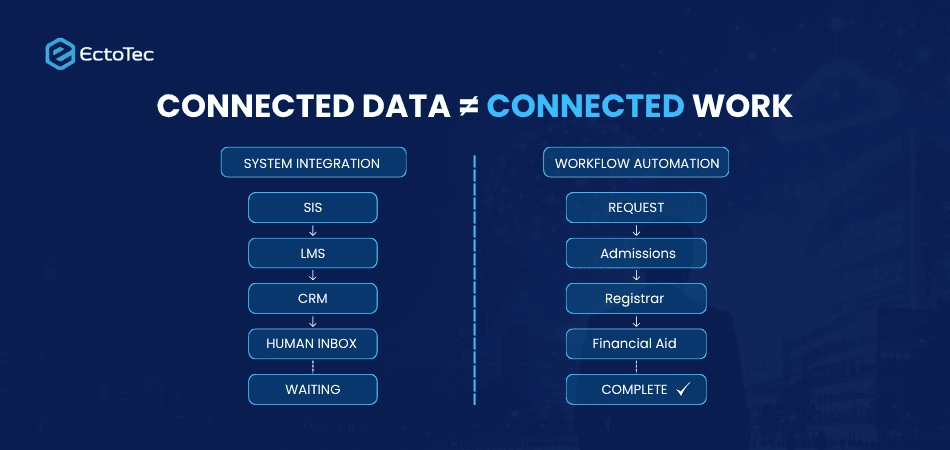
Systems are connected through integration. The work that takes place between them is not automatically connected. The majority of daily conflict at a university still exists in that gap.

Integra Connectingtion isn't Automation
The two are sometimes jumbled together, so it's important to be specific.
System integration allows two platforms to share data, such as a grade reported in the LMS appearing in a transcript system or a SIS modification reflected in a CRM. On this, the majority of universities have made significant strides.
Automation of workflows is distinct. It concerns what transpires when a request travels not only between systems but also between individuals and departments. The academic department, financial assistance, advising, and the registrar may all be involved in a student's request to switch majors. Even if the systems are flawlessly integrated, the request may remain unfulfilled for days since no one is responsible for transferring it from one office to another.
Because of this, organizations that have made significant investments in integration may yet feel as manual as others that have not. The systems are interconnected. It's not work.

Where the Handoffs Actually Break
This is particularly evident in cross-departmental procedures, where multiple offices must act sequentially and nothing automatically signals the following office when it's their turn.
Go from admissions to enrollment. After being accepted, a student's file must go from admissions to the registrar, financial assistance, and finally an academic department for counseling. These days, each handoff typically relies on a shared spreadsheet, an email, or someone remembering to check a queue.
HR, IT, payroll, and facilities all use the same onboarding procedure. HR accepts a hire, but facilities don't automatically know how to set up a workspace, and IT doesn't immediately know how to provision accounts. Each process depends on someone noting the completion of the previous one.
Curriculum modifications are processed by an academic department, the registrar, and occasionally the provost's office. Frequently, there is no common understanding of the present status of a request or the individuals involved.
The issue is not with the departments. There is no method in place to link them.
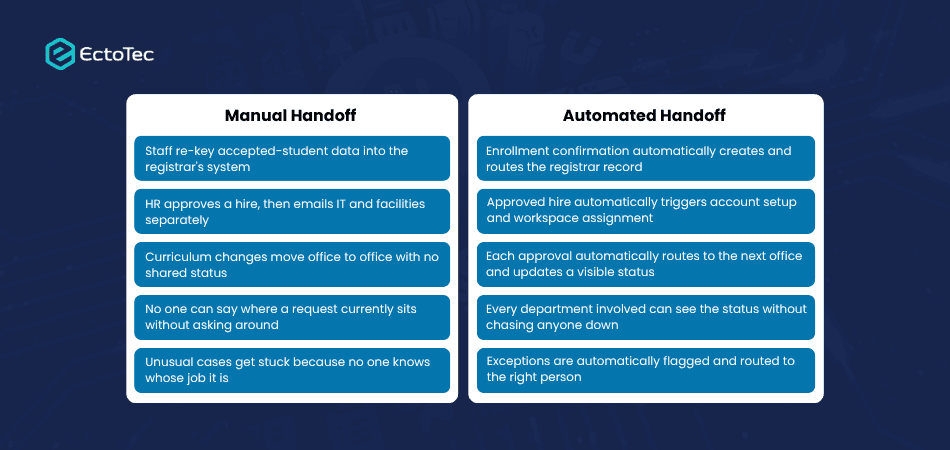
Nearly every administrative function exhibits the same pattern, even in cases where the underlying systems are already integrated. Examples include accepted student data being rekeyed for the registrar rather than routed automatically, an approved hire that IT and facilities only learn about indirectly, curriculum changes with no shared status, and room requests being tracked in a spreadsheet that is only maintained by one person. These don't rely on any new systems. They rely on considering the handoff as something that can be automated, not simply the data.
What This Looks Like in Practice
Giving a process, not just a system, a predetermined path so that a request advances automatically when each stage is completed is known as automating cross-department workflows.
In actuality, a request does not reside in someone's inbox, but rather has a visible status that is available to all parties concerned. Instead than waiting for someone to convey the update, the completion of one step promptly initiates the next financial assistance notification as soon as enrollment is confirmed. Routine cases proceed on their own, and exceptions are only sent to an individual when a matter truly requires a ruling.
Because it involves more people and more conflicting priorities, getting there is more difficult than automating an internal procedure in a single office. The first step is to map out how the process actually operates today, taking into account unofficial workarounds like the person who everyone emails when something goes wrong. It requires shared ownership: a workflow including financial assistance, admissions, and the registrar requires consent from all three offices, not just one. Additionally, a workflow can only automate a handoff provided the systems are able to transfer the data that the handoff depends on; this still requires strong connectivity underneath.
What Manual Handoffs Cost You
The clearest way to see whether a process needs this kind of automation is to look at what's actually happening at each handoff point today:
If most of your cross-department processes look like the left column, that's where automation has the most to offer. If a process is already closer to the right column, it's probably not worth touching yet.
Building a Path Toward Connected Workflows
Instead of attempting to automate everything at once, most organizations begin with one high-friction operation. Onboarding and admissions-to-enrollment are frequent beginning points for many departments, occur continuously, and have a definite cost when they stall.
Then, before automating any of it, get the departments together to decide on the process itself, including who owns each step, what the handoffs are, and what constitutes an exception. Since a cross-department workflow lacks a natural owner unless one is designated, governance is more important here than in single-department automation.
Once a workflow has proven successful, the same playbook maps it, aligns the departments, and then automates the handoffs that often spread on their own.
Conclusion The Work Matters as Much as the Data
Real progress has been made by universities in integrating their systems. Connecting the work that takes place between them handoffs and approvals, which still rely on someone remembering to act is the next step.
Requests move more quickly, fewer items slip through the cracks between departments, and employees spend less time chasing status updates that should have moved on their own when workflows are automated rather than just systems.