




6 min read
Designing Ethical & Responsible AI Workflows in Higher Education Systems



The Expanding Role of AI in Higher Education Systems
These days, AI is crucial to understanding student behavior and institutional performance. Students who might need more academic support can be identified with the aid of predictive analytics. Timely messages are triggered by automated workflows. Leadership dashboards offer up-to-date information on retention risks, engagement trends, and enrollment trends.
Integration of LMS and SIS platforms greatly improves these capabilities. When combined, they provide a cohesive data base that enables organizations to transition from reactive to proactive, insight driven solutions. However, the influence of poorly controlled systems also grows as AI becomes more prevalent in academic processes. Lack of transparency or accountability might cause algorithms to inadvertently reinforce bias, obfuscate decision rationale, or erode teacher and student trust.
For organizations dedicated to responsible innovation, ethical AI is consequently a practical necessity rather than an abstract idea
What Ethical and Responsible AI Means in Higher Education
In higher education, ethical AI is concerned with the development, application, and regulation of intelligence in academic institutions. Throughout their lifecycle, it guarantees that AI-driven insights are equitable, comprehensible, safe, and accountable.
In reality, responsible AI workflows deal with issues including how predictions are made, how student data is handled, and how results are evaluated. Additionally, they guarantee that automated insights promote institutional objectives without jeopardizing student equity or privacy. Institutions are increasingly integrating governance directly into their AI-enabled platforms rather than considering ethics as an add-on
Why SIS and LMS Integration Increases Ethical Responsibility
By merging structured SIS data such as enrollment, grades, and demographics—with LMS data on engagement, participation, and learning behaviors, integrated academic systems uncover potent insights. This integration raises accountability while also improving context and accuracy. Systemic injustices may be reflected in historical data. Complex student situations may be oversimplified by automated alerts. Executive dashboards could draw conclusions without providing enough information into the methods used to arrive at those findings.
By guaranteeing that integrated intelligence stays impartial, open, and useful, ethical AI workflows assist organizations in striking a balance between innovation and accountability.
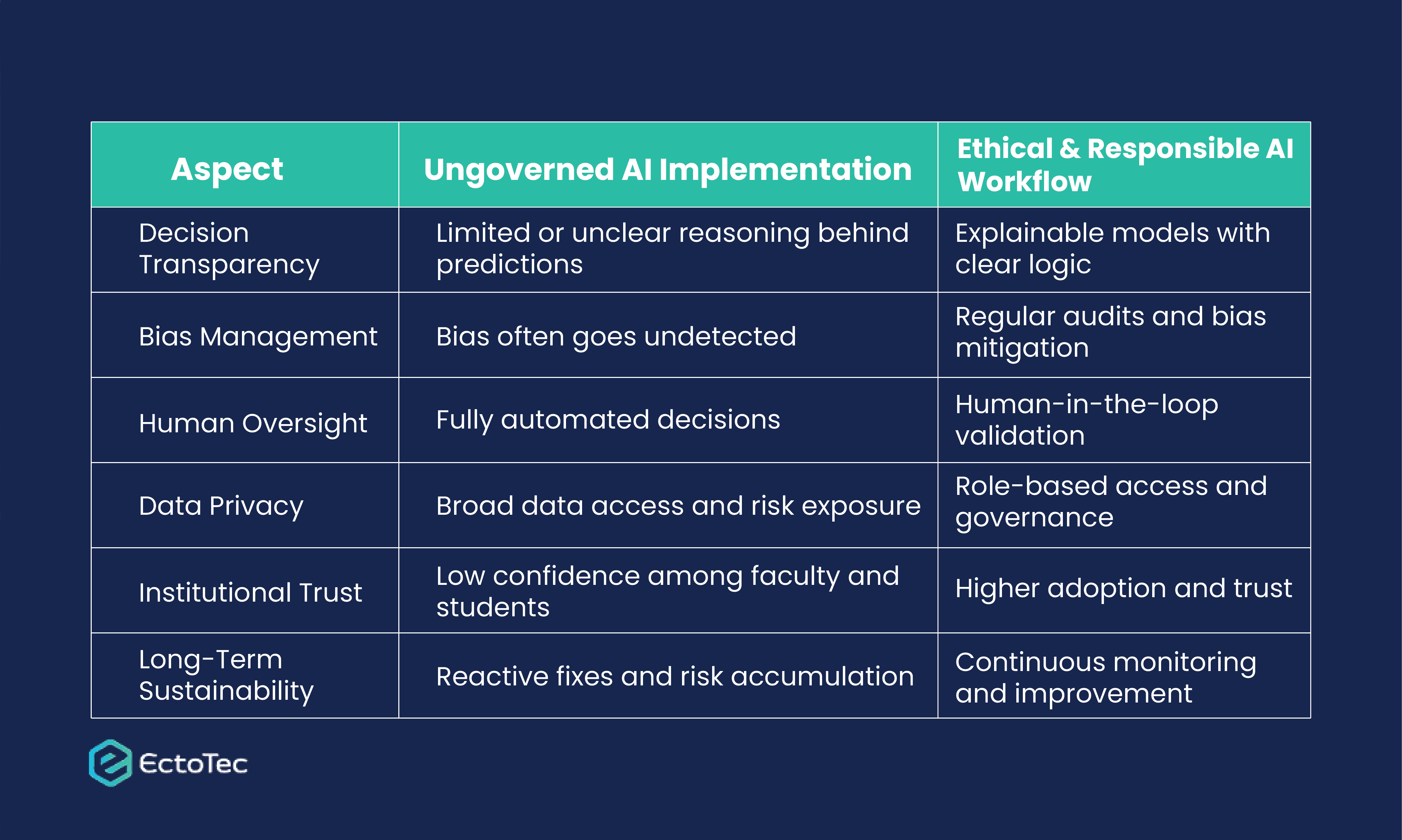
Ethical AI vs Ungoverned AI: A Practical Comparison
The difference between responsible and ungoverned AI becomes clear when comparing how each approach impacts institutional outcomes.
This comparison highlights why governance is not a barrier to innovation, but rather a foundation for sustainable AI adoption
Core Principles for Designing Responsible AI Workflows
Openness is crucial. Advisors, teachers, and administrators must be able to comprehend insights produced by AI. When a referral is made or a student is marked as at risk, the justification should be clear and understandable. Human supervision is still crucial. AI should assist decision-making, not take its place. Particularly in complex academic circumstances, advisors and instructors provide context that algorithms are unable to fully grasp.
Fairness needs to be closely watched. Continuous assessment is a component of ethical AI workflows to guarantee that forecasts and suggestions continue to be fair across student populations, programs, and modalities. All responsible AI initiatives are based on privacy-first governance. Clear regulations for sensitive student data access, usage, and retention are necessary for integrated LMS and SIS settings.
Finally, as data trends and institutional agendas change, ongoing monitoring guarantees that AI systems continue to be accurate and pertinent.
Ethical AI in a SaaS-First Higher Education Environment
Ethical AI is becoming more important and scalable as academic institutions move toward SaaS-based systems. Centralized governance, uniform policy enforcement, and simpler cross-platform audits are all supported by cloud-native solutions. Adoption of SaaS, however, necessitates that organizations specify accountability and ownership for AI-driven procedures. While coordinating technology capabilities with institutional ideals, responsible workflows assist institutions in keeping control over how intelligence is used within vendor ecosystems.
Practical Applications of Ethical AI Workflows
Predictive analytics can direct advisors toward prompt interventions in student success efforts. These insights are always evaluated in light of the unique experiences of each student, and ethical design guarantees that they are supporting rather than deterministic.
AI can provide engagement patterns and educational potential in learning analytics. Rather than focusing on behavior monitoring, responsible implementation aims to improve student results and course design. While ethical frameworks guarantee that decisions are based on precise, contextualized, and transparent data, AI-powered dashboards at the leadership level facilitate strategic planning and resource allocation.
Measuring the Impact of Responsible AI
AI success should be assessed by organizations using more criteria than only technical precision. Trust and adoption among instructors and advisers, the success of interventions, and quantifiable increases in engagement and retention are important metrics
Governance becomes visible, actionable, and quantifiable when ethical AI concepts are integrated into analytics dashboards and reporting platforms.
Conclusion
Creating ethical and responsible workflows is becoming essential as AI becomes more integrated into higher education systems. Unprecedented insight is provided by integrated LMS and SIS platforms, but in the absence of control, transparency, and human oversight, this intelligence may actually increase risk rather than add value.
Organizations are better positioned to expand analytics, build trust, and maintain long-term. digital transformation when they include ethical principles into AI operations. Universities can take advantage of innovation while maintaining academic integrity, equity, and student welfare thanks to responsible AI.
AI that is ethical does not impede advancement. It guarantees that advancement is sustainable, inclusive, and meaningful.