



6 min read
Embedding Predictive Analytics in Canvas LMS to Boost Student Engagement



What Is Predictive Analytics in Canvas LMS?
Before we get into implementation methodologies, let's clarify what we mean by predictive analytics in Canvas LMS.
Canvas LMS currently provides teachers and administrators with comprehensive data dashboards covering everything from assignment submission habits to participation indicators. When we talk about embedding predictive analytics in Canvas, we mean:
The use of historical and real-time data to predict future student behavior.
Analytical models that identify trends in engagement signals.
Forecasting techniques that identify students at risk based on academic conduct, participation trends, and interaction footprints.
Together, these features elevate Canvas from a course administration system to a proactive learning system capable of suggesting individualized interventions, recommending resources, and alerting teachers before a student disengages.

Why Predictive Analytics Matters for Student Engagement?
Today's students face increasingly difficult academic journeys. Students confront more hurdles than ever before, including combining employment and study and adapting to mixed learning environments. In this environment, student engagement is an important predictor of success. According to research, higher levels of involvement are associated with higher grades, increased retention, and a stronger sense of belonging.
Embedding predictive analytics in Canvas LMS allows institutions to intervene quickly, before engagement decreases become failures. It enables instructors to:
Identify disengagement patterns several weeks before grades decline.
Tailor outreach methods to the needs of each student.
Align curriculum design to current engagement trends.
Increase overall course satisfaction and learning results.
From a strategic standpoint, AI in higher education is more than just a term; it is a driver for increasing student outcomes and institutional performance.
Practical Steps to Activate Canvas Analytics for Personalized Learning
Here's how colleges may use predictive analytics in Canvas LMS to create significant increases in student engagement:
1. Audit Your Data Environment
Before installing predictive models, it is critical to have a thorough grasp of the data in your Canvas LMS. You should be aware of the engagement metrics that are already being recorded, such as page views, assignment submissions, and discussion participation. It's also critical to evaluate how comprehensive and clean your data is across learners and courses. A thorough data audit helps highlight the most important indicators and ensures your Canvas instance is ready for advanced analytics.
2. Define Engagement Signals That Matter
Not all Canvas data points are equally indicative of student achievement. It is critical to focus on signals that have historically demonstrated substantial relationships with beneficial outcomes, such as weekly login frequency, time spent on learning modules, engagement in conversations and group work, completion of low-stakes exams, and early submission trends. Establishing a baseline of these key performance indicators (KPIs) allows institutions to better build predictive models, resulting in faster creation of accurate and actionable insights.
3. Build Predictive Rules Tied to Engagement Signals
After you've set your engagement signals, the next step is to incorporate predictive algorithms that can provide alerts or suggestions within Canvas or other analytics tools. Examples include:
"Login frequency drops below threshold" - notify instructor.
"First three assignment grades below course average" → Flag Student
"Discussion participation rate falls 30% below peer average" - trigger outreach effort.
"Rapid decline in time spent on weekly modules" → Recommend scholarly resources.
Predictive rules can help institutions transition from reactive data reporting to proactive student assistance systems.
4. Integrate Predictive Models With Canvas Dashboards
Canvas offers analytical dashboards to visualize engagement numbers, but predictive algorithms enable foresight. Integrating predictive analytics tools, such as API connections or Canvas-native analytics extensions, allows instructors to evaluate present engagement and future risk in a single interface.
This unified perspective allows instructors to make real-time decisions without switching platforms.
5. Train Staff on Interpreting Predictive Insights
Analytics is only useful if it can be interpreted and applied by humans. Institutions should invest in educating professors and advisors about:
Understanding Predictive Risk Scores
Distinguishing between correlation and cause
Using dashboards to inform instructional decisions.
Communicating with kids using data insights
Training transforms Canvas analytics into a tool for human-centered decision-making, beyond just reporting.
6. Monitor, Evaluate, and Iterate
Once predictive analytics are operational, it is critical to collect input and assess their effectiveness via a continuous improvement cycle. This includes checking model accuracy and changing engagement criteria as needed, asking instructors for feedback on alerts and recommendations, and testing new data inputs as they become available. Measuring outcomes such as increased course completion rates or student satisfaction scores can also help determine efficacy. Adopting this iterative method guarantees that your predictive analytics strategy evolves in accordance with learner demands.
Examples of Predictive Rules Tied to Engagement Signals
To put these principles into action, here are some examples of predictive rules that directly link Canvas engagement data to actionable alerts:
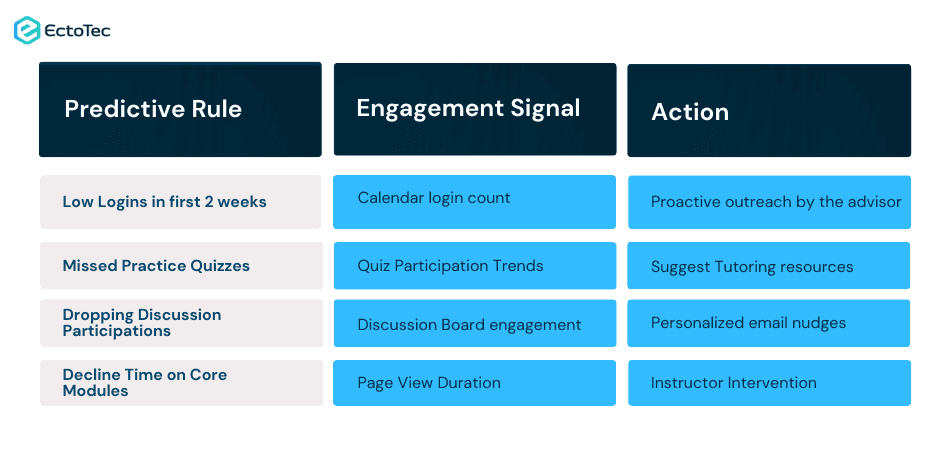
By using past behavior to forecast future results, these regulations allow teachers and counselors to take action before risky behaviors turn into academic failures.
The Role of AI in Higher Education and Canvas Analytics
A larger change in education is reflected in the move toward AI-driven predictive analytics. Institutions want systems that forecast, prescribe, and personalize; they are no longer content with static reports.
Schools benefit from incorporating predictive analytics into Canvas:
A more thorough comprehension of how students engage with the material
The capacity to predict which pupils are most likely to lose interest
Sensible suggestions based on each learner's unique route
Scalability that accommodates thousands of students without taxing staff
The true potential of AI in higher education lies in its ability to improve human decision-making through data-driven insight.
Conclusion: Turning Engagement Data Into Student Success
Predictive analytics in Canvas LMS is a strategic advantage rather than merely a technical improvement. By spotting risk early, tailoring support, and encouraging deeper participation throughout the academic lifecycle, institutions that successfully use Canvas analytics can completely change the student experience.
Embedding analytics into Canvas opens the door to a future where students flourish, and data influences decisions, from genuine predictive rules to practical implementation processes.
Now is the moment to take action if your organization is prepared to transition from descriptive analytics to a world where Canvas LMS actively promotes student engagement through predictive insight.