




6 min read
Faculty Burnout? How AI-Driven LMS Tools Can Lighten the Load


The Growing Problem of Faculty Burnout in Higher Education
Faculty burnout poses a significant challenge, marked by emotional exhaustion, a sense of detachment, and diminished effectiveness, which often leads to a decline in the quality of teaching and reduced student engagement. Contributing factors to this issue include excessive workloads, administrative responsibilities, and insufficient support from the institution. Responsibilities such as grading a large number of students, overseeing online discussion boards, and managing multiple course platforms increase stress levels, often resulting in staff turnover and hampering student learning.
For instance, an instructor handling over 200 students across several online courses may dedicate hours to answering common inquiries, leaving minimal time for lesson planning or personalized guidance. High levels of turnover and decreased engagement adversely affect the overall performance of the institution, creating a ripple effect that extends beyond individual educators. Burnout prevention necessitates balanced tasks, mental wellness resources, and the intentional use of modern technology tools, including artificial intelligence, to assist instructors and improve learning results
How AI Is Transforming Faculty Support
Artificial intelligence is altering faculty roles, transforming educators from knowledge providers to guides and mentors. AI-enhanced customisation enables educators to create diverse learning experiences while assisting students in understanding complicated content and AI-generated insights.
AI solutions now offer automatic grading, smart observations, and topic recommendations, minimizing repetitive duties and allowing staff to focus on more impactful teaching. For example, AI-generated lesson reports can highlight regular student faults, allowing instructors to personalize their teachings more effectively. Reports on performance and predictive analytics
enable professors to track engagement and interact with students at risk early on.
AI chatbots and smart notifications are examples of streamlined communication tools that further minimize administrative expenses. Many universities are testing AI-powered LMS tools as well as research assistants to improve decision-making. The revolutionary promise of AI for professors is obvious: it enables educators to provide individualized, successful training while
managing workload more wisely.

AI-Driven LMS Productivity Tools That Reduce Faculty Workload
Modern LMS platforms, when effectively connected, can greatly lessen the workload for faculty while enhancing efficiency. LMS technologies work in conjunction with institutional systems to simplify course management, automate routine tasks, and provide real-time dashboards for student analytics. These features allow educators to monitor participation, pinpoint educational gaps, and adjust their teaching methods.
For instance, an automated system can highlight overdue assignments or generate progress reports for large groups, saving faculty significant time each week. Smooth integration of LMS, enhanced course management, and automated processes allow instructors to prioritize teaching and student support rather than getting bogged down by repetitive administrative duties. Although some AI-driven features may vary by platform, educational institutions can effectively leverage these tools to assist staff, prevent burnout, and maintain high standards of instruction
Benefits of AI-Powered Digital Teaching Solutions
AI in education is widely regarded as a catalyst for innovation, boosting teaching and learning results. Chatbots, AI-assisted learning platforms, and data-driven decision support systems improve efficiency and customisation. Earlier AI applications focused on examinations and automatic scoring, but newer systems provide learning to adapt, future findings, and personalized
feedback.
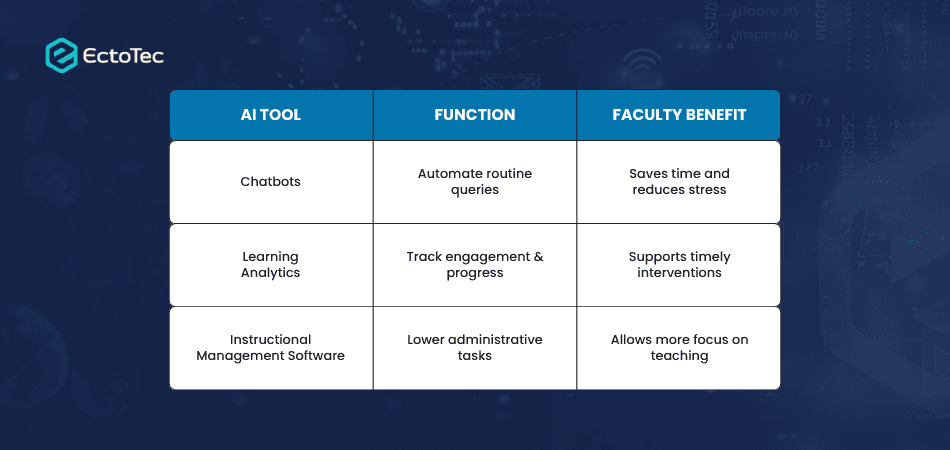
Chatbots, for example, can respond to routine student inquiries, whereas analytics dashboards can detect engagement trends, allowing staff to get involved before students fall behind. Instructional management software helps educators by lowering administrative hassles and offering more in-depth insights into how students perform.
To illustrate, the table below shows how key AI tools benefit faculty
Strategic Adoption of Faculty Support Technology
Successfully implementing AI and LMS tools necessitates a planned, institutional-wide approach. Comprehensive faculty training, cross-disciplinary cooperation, and involvement of stakeholders help educators use these tools effectively. Research reveals that elements such as training , accessibility, administrative assistance, and infrastructure have a substantial impact on
faculty willingness and capacity to use LMS systems.
For example, focused training on AI analytics can help instructors evaluate student data more quickly, decreasing decision-making fatigue and work stress. Combining technical resources with human help fills gaps in digital preparedness and pedagogical adaptation. Targeted institution measures—technical, pedagogical, and administrative—enable faculty to use AI tools while overcoming constraints such as limited competence or ethical concerns. By focusing faculty support technology and coordinating adoption with strategic thinking, institutions may promote inclusive, productive, and future-ready educational settings while reducing burnout.
Conclusion
Artificial intelligence-powered tools and current LMS systems are revolutionizing higher education by lowering faculty workload, boosting teaching quality, and enabling tailored learning experiences. Strategic use of faculty support technology, integration with LMS platforms, and extensive training allow educators to focus on high-impact teaching and mentoring. These technologies help professors rather than replace them, resulting in more efficient, inclusive, and student-focused learning environments. Institutions that use AI and digital teaching solutions intelligently can increase faculty well-being, minimize fatigue, and stimulate innovation, ultimately improving outcomes for students as well as teachers