




6 min read
From Fragmented to Connected: How Integrated University Systems Improve Student Success



Introduction — Why Fragmented Systems Are a Student Success Problem
University is not perceived by students as a collection of disparate disciplines and disjointed platforms. They see it as one continuous trip. However, the majority of schools function in silos behind the scenes, utilizing distinct systems, data, and procedures for student life, academics, admissions, and advising that hardly ever interact with one another.
At every level of the student experience, this gap causes unseen friction. These are not isolated annoyances, such as missed deadlines because of incomplete information, confusion from browsing several portals, and delayed assistance when it is most required. They are signs of a more serious institutional issue that subtly undermines retention, engagement, and belonging.
Fortunately, fragmentation is not unavoidable. Measurable increases in student achievement and operational effectiveness are already being shown at universities that invest in linked, integrated systems. The question now is not whether integration is important, but rather how fast institutions can get there.
Enrollment: Where the First Cracks Appear
The moment a prospective student submits an application marks the beginning of the student adventure, which starts well before orientation day. However, this crucial initial interaction is anything but smooth for many colleges. Communication gaps caused by disjointed admissions, recruitment, and CRM platforms deprive candidates of timely updates, redundant outreach, or worse, total silence during critical times.
The gaps are immediately apparent when marketing, application monitoring, and student record-keeping are all conducted on different systems. Administrative teams waste time manually moving data between platforms, advisors are unable to see the status of applications, and prospective students receive inconsistent messaging.
In higher education, first impressions have a lasting effect. When an applicant has difficulties and misunderstanding during the enrolling process, they don't just forget about it once they get to campus; instead, they carry that displeasure with them into all of their future interactions with the school.
Onboarding: Where Students Get Lost in the Gaps
Instead of seeing onboarding as a continuous, assisted transition into academic life, many colleges regard it as a single orientation week. Because of this limited perspective on onboarding, schools lose kids long before they face academic difficulties.
It is hard to ignore the fractured reality. As soon as they arrive, students encounter a labyrinth of disjointed procedures, such as restricted visibility into advising availability, confusion over course registration, delayed access to student portals, and information overload during orientation. The cumulative effect of these friction points is overwhelming when they accumulate across disparate departments without unified monitoring, even though each one is manageable on its own.
A student does not feel welcomed by their institution; rather, they feel abandoned if they are unable to access their LMS on day one, miss a financial aid deadline because of disjointed communication, or find it difficult to schedule an adviser visit during their first week. If ignored, that emotion turns into the initial stage of disengagement.
Academic Progression: Silos That Let Students Fall Behind
It is expected that the school will actively monitor a student's development once they have enrolled and settled in. Academic progress is really monitored by a number of disparate systems at the majority of universities: the LMS keeps track of interaction, the SIS stores academic records, advising platforms handle appointments, and analytics tools are kept apart from all of these systems. These systems don't naturally communicate with one another.
There are serious repercussions. Without a single alert being set off, a student may be ignoring their advisor, skipping assignments in the LMS, and falling behind on credits in the SIS all at the same time. When a single system raises an issue, the problem has already gotten out of hand.
Institutions can only take proactive action when they have a comprehensive, up-to-date image of every student. Disconnected systems stop that vision from ever emerging in the first place, not just postpone it.
Student Support: When Help Arrives Too Late
Only when it reaches students at the appropriate time can student support be helpful. Institutions are unable to view the whole picture of a student's circumstances when data is divided between financial assistance, counseling, advising, and academic systems. This blind spot has serious repercussions.
Three or four distinct platforms may show bits of a student who is discreetly dealing with financial stress, deteriorating grades, and decreased involvement. However, no adviser or member of the support team ever sees the whole picture in the absence of a unified view. The harm has already been done by the time intervention is initiated, which is frequently done manually or by a student reaching out on their own.
Having the appropriate services in place is not enough to provide effective student assistance. It is about making sure those services are informed, connected, and capable of taking action before a brief conflict turns into a permanent leave.
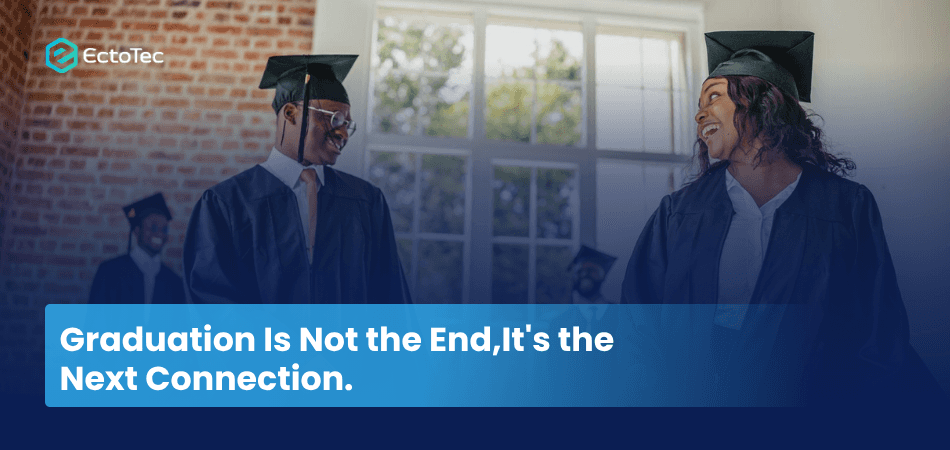
Graduation and Beyond: Keeping the Connection Alive
Graduation is not the end of the student journey, but for many institutions, the relationship does. Career assistance, alumni involvement, and chances for lifelong learning seldom reach students in a timely or meaningful manner once they cross the stage due to disconnected systems.
There are several reasons why this is a lost opportunity. By providing specialized career help, alumni networking, mentorship opportunities, and continuous learning pathways that prolong the institutional relationship well beyond commencement, connected technologies enable institutions to smoothly move from assisting students to engaging graduates.
Benefits are reciprocal. Graduates who stay in touch serve as recruiters, benefactors, mentors, and ambassadors for the school. They enhance the institution's reputation, recommend potential students, and add to a dynamic, expanding network that benefits all upcoming cohorts.
An organization is losing out on long-term value if it views graduation as a goal. A connected student lifecycle turns a transactional college experience into a collaboration that lasts a lifetime.
What Integration Actually Looks Like
A truly connected student journey is built on systems that share data, communicate in real time, and place the student at the center of every interaction. Here is what that looks like in practice:

Conclusion — Connected Systems, Successful Students
Not only do fragmented systems lead to administrative inefficiencies, but they also create imperceptible obstacles that students must overcome from the time of their initial application until their final graduation and beyond. Every disconnected platform is an opportunity for a pupil to go unrecognized.
Institutions with the most linked technology—rather than those with the most technology—will be the most successful in terms of student achievement. Integration is neither a long-term goal nor a luxury. It serves as the cornerstone of all significant student experiences.
Students are assisted when systems are linked. Students thrive when they receive assistance.