




6 min read
5 Signs Your University's LMS Strategy Is Outdated



Introduction — Is Your LMS Holding Your University Back?
The Learning Management System was meant to be a game-changer for numerous universities. However, reality frequently paints a different picture despite significant investment: distracted pupils, irritated teachers, disjointed data, and routines that impede rather than advance everyone.
Rarely is the platform the issue. The plan underlying it is the true problem. An LMS subtly becomes a hindrance to growth rather than a catalyst when it is viewed as a one-time installation rather than a dynamic, changing component of the organization's digital ecosystem.
The good news? The warning signs are clear. Here are five indicators that your university's LMS strategy is overdue for a transformation.
Sign #1 — Your LMS Operates in Isolation
The entire educational ecosystem suffers when a learning management system operates as a digital island instead of being an essential part of the organization's technology stack. Critical data, including administrative records, engagement indicators, and student performance data, is stuck inside the LMS and cannot readily move to systems that require it most, like the Student Information System, CRM platforms, or advising and analytics tools.
Everyone engaged has a disjointed experience as a result. Teachers manually cross-reference data from several systems, which takes up important time. Advisors don't have the whole student picture necessary to act quickly.
Think of a mid-sized university where the advising platform, SIS, and LMS all run separately. The LMS notifies the academic adviser when a student starts missing assignments, but the information is never shared with them. The student has already dropped the course by the time the problem is manually reported. Students have a disjointed, rather than encouraging, digital trip.
Silos are not affordable for a modern LMS strategy. Nowadays, seamless integration throughout the whole educational technology ecosystem is essential to both student achievement and institutional efficiency.
Sign #2 — Decision-Making Relies on Historical Data Instead of Real-Time Insights
Semester-end reports and yearly surveys are insufficient in today's rapidly changing educational environment. Institutions are effectively operating with a rearview mirror when they rely on manual data collection, batch-processed reporting, and lagging metrics; they only find out that a student is having difficulties long after the chance to assist has passed.
There are actual repercussions. Missed interventions, higher dropout rates, and advisors overburdened with data management rather than helping students are all consequences of delayed reporting. When a struggling kid is mentioned in a report, the situation is frequently already dire.
Real-time visibility is essential to modern LMS strategy. By detecting at-risk students as soon as trends alter, rather than weeks later, live dashboards, automated engagement tracking, and predictive analytics enable institutions to transition from reactive to proactive.

Sign #3 — Students and Faculty Struggle with Adoption
Adoption fails when instructional technology adds more labor than it removes. If instructors and students perceive your LMS as a hindrance rather than a facilitator, it is obvious that your approach needs to be adjusted.
Rarely does this opposition stem from a reluctance to use technology. It results from a platform that doesn't show immediate benefit, uneven experiences, and poor usability. While students only interact with the system when absolutely necessary—logging in to turn in assignments and nothing more—faculty wind up working around it rather than within it.
For instance, a university launches a new learning management system (LMS) with sophisticated features like discussion boards, progress monitoring, and collaborative tools. However, instructors continue emailing instructional slides despite receiving little training. Students completely disconnect since they don't know where to find the materials. Although operational, the platform is mostly unutilized.
The effects extend beyond annoyance. Low adoption silently reduces the return on what is frequently a large institutional investment, directly jeopardizes learning outcomes, and leaves potent platform features entirely unutilized. Because a product is useless if no one uses it, a successful LMS approach must place equal emphasis on user experience and functionality.
Sign #4 — Your LMS Lacks Personalization and AI-Driven Capabilities
An LMS that is static is no longer enough. Students no longer accept content delivery that is one-size-fits-all due to a fundamental shift in digital learning expectations. They anticipate intelligent, customized learning experiences that adjust to their performance, pace, and preferences.
Your organization is lagging behind if your LMS is still only used as a content repository. AI-driven features are rapidly becoming the norm for contemporary Higher Education LMS platforms; they are no longer a luxury. AI turns the LMS from a passive tool into an active driver of student success by identifying at-risk students before they disengage, suggesting individualized learning pathways, and automating support touchpoints.
Institutions that do not use AI-powered learning are losing a major competitive edge in terms of drawing in, keeping, and engaging students—they are not merely missing a feature.
Sign #5 — Your LMS Cannot Support Future Growth
An LMS that is unable to keep up with institutional expansion becomes a strategic bottleneck in addition to a technological annoyance. The technology that supports these goals must advance in step with institutions' expansion into online, hybrid, and lifelong learning models.
It's difficult to ignore the warning flags. Indicators that your platform has reached its limits include slow load times during periods of high enrollment, unplanned system outages, incapacity to manage large-scale video streaming, and inflexible architecture that cannot support new programs or quickly shifting market demands.
Scalability is a strategic concern that goes beyond performance. A future-ready LMS must facilitate data-driven decision-making, offer a variety of learning methods, and use cutting-edge cloud-based infrastructure to lessen operational strain. In addition to risking a subpar user experience, institutions that put off tackling scalability run the danger of lagging behind rivals who are already developing more flexible, growth-oriented digital learning environments.
Building a Future-Ready LMS Strategy
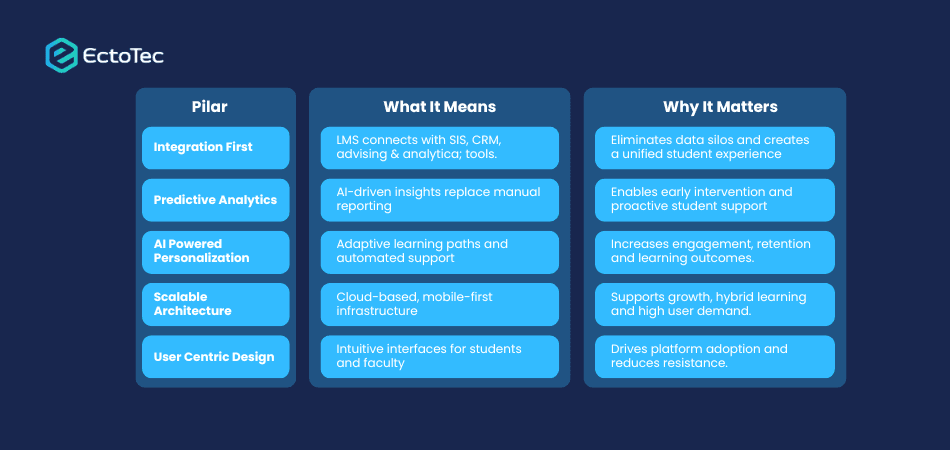
Modernizing an LMS is more than simply a technical improvement; it's a strategic shift that directly connects institutional agility and learning efficacy. An LMS strategy that is ready for the future is supported by a few key pillars:
Conclusion — Modernizing Your LMS Strategy for Long-Term Success
An antiquated LMS approach fails silently, as seen by distracted students, irate teachers, missed interventions, and institutional development that the technology is just unable to facilitate.
The five indicators listed in this blog are not unique technological problems. They are tactical alerts that the distance between your institution's current state and its ideal state is growing with each semester.
Modernizing your LMS strategy is about making a conscious investment in student achievement, operational excellence, and long-term institutional growth rather than following the newest technological trend. Institutions that regard their LMS as a strategic asset to develop rather than as a system to maintain will be at the forefront of digital change.