




6 min read
Personalized Learning at Scale: How AI in LMS Drives Student Engagement in Higher Education


Introduction: The Shift Toward Personalized Learning in Higher Education
Higher education is undergoing a major transformation. Traditional teaching techniques are being replaced by more individualized and flexible learning strategies in educational institutions. The goal of this modification is to accommodate students' varying skill levels, learning styles, and degrees of participation in today's classrooms.
A major factor in this shift is artificial intelligence (AI). It drives intelligent tutoring programs and adaptive learning platforms, enabling instructional materials to change in response to student actions, performance, and preferences. Learning is constantly changing as each learner advances; it is no longer static.
The learner is the main emphasis of personalized learning. Each learner's readiness, level of expertise, and preferred method of learning are taken into consideration when designing instruction. Students can now advance in methods that suit their unique needs rather than adhering to a predetermined pace.
Why Traditional LMS Falls Short in Delivering Personalized Learning
For a long time, structured education has been supported by traditional learning management systems (LMS), particularly in the areas of regulatory learning, certifications, compliance training, and onboarding. They efficiently manage evaluations, monitor progress, and arrange content. For uniform learning settings, this makes them essential.
These solutions, however, employ inflexible, one-size-fits-all delivery strategies that don't accommodate different learning styles.
For instance, regardless of comprehension level, all students in a university LMS receive the same classes, tasks, and deadlines. Both high-achieving and struggling students receive the same treatment; they are not given alternate learning routes or adaptive help.
This disparity is becoming more apparent as education moves toward ongoing, individualized learning. Smarter systems are required to go beyond the distribution of static material.
The Need for Scalable Personalization in Modern Higher Education
Personalized learning boosts engagement by tailoring content to students' needs. This makes learning more applicable and meaningful. Students are more likely to stay involved when the information is appropriate for their level and aspirations.
It also aids educators by delivering real-time data on student performance and conduct. This enables instructors to identify learning deficiencies early and take action rather than waiting for final test results. In a hybrid classroom, for example, students who are struggling can receive additional resources and help, allowing advanced learners to move forward without excessive repetition.
This kind of customization cannot be delivered manually across huge student groups, necessitating the development of scalable, technology-driven alternatives.
How AI Enables Adaptive Learning Experiences in LMS Platforms.
AI transforms LMS platforms into dynamic learning environments rather than static ones. Not every student receives the same content from it. Rather, AI continuously evaluates student data and makes real-time adjustments to learning experiences. To identify trends and forecast individual needs, it examines data such as learner behavior, performance history, and engagement patterns. AI instantly modifies learning tactics, tempo, and content complexity based on this data.
For instance, the system can quickly offer practice questions, more resources, or simplified explanations if a student is having trouble with a certain subject. High-achieving pupils, on the other hand, have instant access to advanced content.
By guaranteeing that students are consistently challenged at the appropriate level, this real-time adaptability increases both engagement and information retention.
AI-Driven Insights in Student Learning Behavior
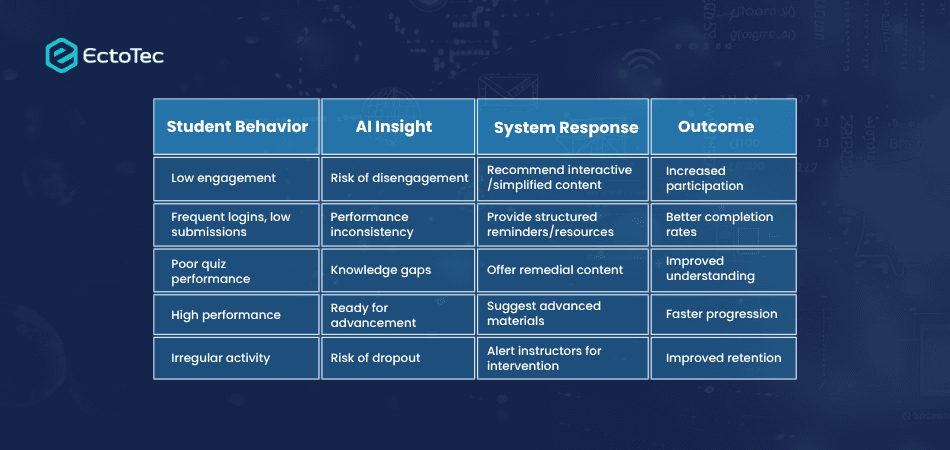
Delivering Personalized Learning Experiences Across Large Student Populations
AI increases engagement by making education more responsive, relevant, and engaging. It offers immediate feedback, presents real-world scenarios, and encourages student choice. This keeps students engaged and motivated.
Additionally, it provides AI-driven support for instantaneous concept clarification, tailored learning routes, and personalized recommendations.
Scaling personalization for thousands of kids is still quite difficult, though. AI is crucial in this situation. By automating customization, it makes learning flexible and consistent without increasing the workload of teachers.
Conclusion: Impact of AI-Driven Personalization on Student Engagement and Performance
Higher education is evolving thanks to AI-driven personalization, which makes learning more dynamic, student-centered, and engaging. Institutions may greatly increase student interest and engagement by tailoring content to each student's requirements.
Because students are given the appropriate resources, challenges, and assistance according to their performance, it also improves academic results. Instead of following a predetermined learning path, students advance in ways that correspond with their ability. AI also improves student happiness and retention by creating a positive learning environment where students witness continuous improvement and feel inspired.
In the end, AI transforms education into a more individualized and significant experience where each student has the chance to thrive.