




6 min read
The Adoption Challenge: Ensuring Faculty and Students Thrive with LMS/SIS


Introduction - The LMS/SIS Adoption Gap
As institutions of higher learning adapt to the rapid growth of Information and Communication Technologies (ICT), they increasingly utilize digital tools to enhance educational experiences, streamline administrative processes, and improve campus operations. Central to this effort are the Student Information System (SIS) and Learning Management System (LMS), which are essential resources in higher education. The SIS is responsible for managing student records, registration, and administrative tasks, while the LMS is dedicated to providing and monitoring learning experiences. When these systems are effectively integrated, they offer a unified platform to address both academic and operational needs
Nonetheless, the integration of these technologies is not a straightforward process. Instructors may have difficulty adapting to new digital processes, while students often perceive platforms as challenging or not user-friendly. At the same time, colleges are incorporating artificial intelligence (AI) into their IT systems to streamline administration, provide analytical insights, and create customized learning experiences. In addition to technology, artificial intelligence (AI) is reshaping institutional operations, influencing competitive edges, long-term success, and the digital transformation of campuses.
Understanding LMS/SIS Adoption Challenges
When attempting to successfully implement LMS and SIS, universities encounter a number of frequent obstacles. The primary problems consist of:
Technological limitations (internet, devices, system speed)
Lack of faculty and student training/support
Resistance to change and low acceptance
Usability and design issues
Motivation and perceived value
Institutional policies and support
These challenges are often interconnected. For example, a faculty member might be hesitant to utilize SIS tools if they fear it will lead to an increased workload, while a student may have access to an LMS but face difficulties due to its confusing design or lack of support. Inconsistent backing from the institution, low self-efficacy, and technological constraints can all worsen these issues, resulting in decreased adoption and participation. To ensure that both educators and students can effectively use LMS and SIS for educational and administrative success, coordinated efforts that consider technology, human aspects, and institutional policies are essential to tackle these challenges.
The Human Factor: Barriers for Faculty and Students
Although human factors frequently create obstacles, faculty and students play a crucial role in the implementation of LMS and SIS. Teachers may be reluctant to adopt digital tools because they are unfamiliar with them, are afraid of taking on more work, or don't trust the features of the system. On the other side, a variety of platforms, difficult navigation, and irregular workflows might overwhelm students.
Thankfully, this gap can be filled with the use of AI-powered assistance solutions. Faculty and students are guided by chat assistants, adaptive tutorials, and tailored recommendations that lower the learning curve and increase confidence. Universities may promote more participation and guarantee that LMS and SIS technologies are used efficiently around campus by addressing these human hurdles.

Practical Steps to Boost Faculty and Student Adoption of LMS/SIS
Successful LMS and SIS deployment necessitates realistic techniques that directly address the issues that instructors and students confront. Based on previously recognized challenges such as poor confidence, platform complexity, lack of involvement, and uneven institutional support, institutions can take the following steps:
Targeted faculty support: Plan conferences and onboarding seminars to teach professors about system features. Quick wins, such as automatic evaluations, curriculum templates, or enhanced communication tools, can help minimize resistance to adapt and boost comfort in digital tools. Recognize and recognize faculty members who make use of the platform to set good examples.
Improving student engagement: To address usability difficulties, simplify dashboards and provide mobile access. Introduce gamification, interactive elements, or step-by-step instructions to overcome lack of inspiration and digital literacy gaps. Communicate the benefits of LMS/SIS clearly, demonstrating how it helps track assignments, communicate, and thrive academically.
Institutional support: Includes maintaining responsive helpdesks, providing consistent policies, and including LMS/SIS learning into orientation sessions. This reduces inconsistency in support from institutions and ensures that students and staff receive dependable guidance. Encourage cross-departmental collaboration so that courses have identical requirements, reducing misunderstanding.
By combining faculty training, student-friendly technologies, and strong institutional support, colleges may directly address barriers to adoption and ensure that instructors and students thrive with LMS/SIS platforms.
The Role of AI and Tools for Adoption Support
AI plays an important role in making LMS and SIS implementation easier by offering automated, tailored, and scalable support to both professors and students. Rather than depending exclusively on human processes, institutions can deploy AI solutions to instruct users and assure consistent participation.
For example, AI could automate participation tracking and arrange appropriate training sessions depending on user activity, such as a fresh login or low platform utilization. System-driven reminders and alerts promote compliance by encouraging teachers and students to attend critical training and onboarding sessions.
To further illustrate how AI supports adoption, the following table highlights key use cases and their impact:
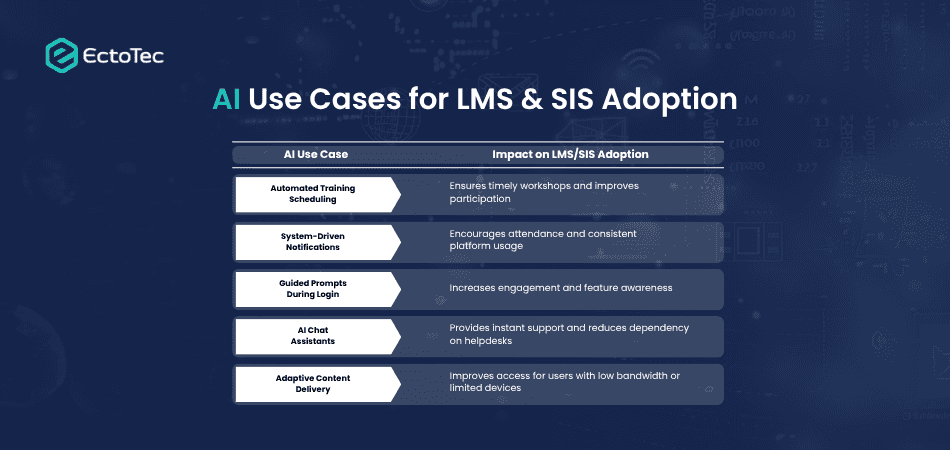
To increase engagement, institutions can employ guided prompts or mandated onboarding procedures during logging into the system encouraging users to explore crucial features or perform critical activities. For example, when a student logs in, he or she may see a popup showing unfinished tasks or platform functionalities, which can help with low motivation and increased consistency.
AI can also help consumers with technological restrictions by customizing content according to device kind or internet speed, resulting in more seamless access across varied environments. Furthermore, AI-powered chat assistants give immediate assistance, which enhances the entire user experience.
By combining these AI-powered capabilities, institutions can develop a more structured, interesting, and efficient adoption process, promoting long-term success and campus digital modernization.
Conclusion — Adoption as a Long-Term Goal
LMS and SIS adoption is more than just a technical implementation; it is a continuous process that demands alignment of people, strategy, and technology. As colleges progress toward digital transformation, addressing adoption difficulties for both staff and students becomes critical to maximizing the value of these platforms.
Institutions can progress from basic implementation to meaningful and sustained engagement by combining organized training, user-centered design, institutional support, and AI-driven tools. When adopted properly, LMS and SIS technologies can be significant accelerators of better teaching, more efficient administration, and improved student outcomes.
Universities that prioritize adoption as a long-term objective will be better positioned to create resilient, efficient, and future-ready campuses, ensuring that both professors and students can succeed in a constantly changing educational landscape.