




6 min read
The 7 Digital Frictions Hurting Student Retention — And How AI Can Fix Them in 2025



1. Poor User Experience on Learning Platforms
The most obvious obstacle among students is a poor user experience of learning management systems (LMS) and learning platforms. The complicated navigation, slow page loads, and user-unfriendly interfaces are problematic for many students. Even established platforms, like Canvas LMS, may overwhelm students when they are not created right or when the material is misorganized.
A negative experience will increase frustration, reduce participation, and ultimately cause course drops or program failures.
Personalization through AI improves the user experience by customising the dashboards, focusing on valuable content, and steering the students on the learning paths that best fit their talents and preferences. Adaptive AI systems can highlight assignments, suggest materials, and restructure course materials depending on individual achievement.
Use case: AI dashboards can be added to the Canvas LMS of several US universities, where students receive individual recommendations and reminders.This approach has increased student engagement and contributed to the increase in the course completion rates.

2. Fragmented Platforms and Data Silos
Most colleges and universities have a lot of software systems; grades, attendance, financial aid, and course materials are often stored in different databases such as Ellucian Banner. The failure of these systems to communicate effectively results in a fragmented learning process for the students. This is a gap that can complicate the process of monitoring the performance of students at the school level.
Disrupted information makes the response slow and misses chances to assist challenging children.
AI can put together all these sources of data to create a unified student portrait. AI provides insights into the behavior of students based on the analysis of the data on LMS platforms, engagement tools, and administrative systems, which enables professors and advisors to identify at-risk students beforehand.
Use Case: In Latin America, universities have implemented AI-based links between Ellucian Banner and their LMS, which enables those students who are not performing well in certain courses to be identified early. The resulting outcome has been an increased retention and easier academic paths.
3. Manual Administrative Processes
Manual processes are still being used in many institutions in areas such as attendance tracking, grading, and dispatching of reminders. Such delays could frustrate children and make them unable to get timely help with their academic problems.
Paperwork is subject to error and is sluggish in offering support, thus lowering student participation and retention.
AI can be used to automate routine activities such as grading quizzes, monitoring attendance, and sending alerts. This enables the administrative personnel to concentrate on individual student support and mentoring.
Use Case: U.S. educational institutions that apply AI to automated grading and attendance checks have reduced the turnaround time and increased student satisfaction, leading to decreased rates of dropouts.
4. Lack of Personalized Learning
Large-scale teaching approaches cannot be used any longer in contemporary higher education. Conventional methods often do not take into consideration the different learning paces, styles, and understandings of students.
The students who are not supported or lost in the curriculum are more likely to disengage.
With the help of student performance data, AI algorithms offer personalized learning. Individualized study plans and adaptive tests, as well as personalized recommendations of the materials, allow students to study at their own pace.
Use Case: Predictive analytics may be used to determine which students are having issues with certain concepts and suggest tutoring or other resources. This approach has led to proven improvement of student retention and performance in the United States and Latin America.
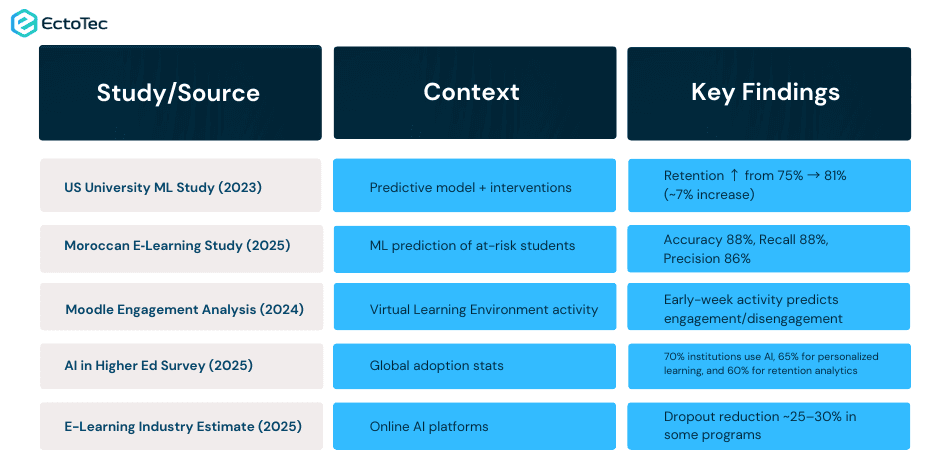
The positive impact of AI on student retention is not just theoretical; multiple studies and industry reports demonstrate measurable improvements across different institutions and platforms.
These findings highlight how AI not only identifies at-risk students early but also improves engagement and reduces dropouts across diverse institutions.
5. Delayed Communication
One common pain point is communication delay. Students wait for days for an answer to an administrative question, clarification of an assignment, or academic advice.
Slow responses frustrate students and disconnect them from the institution.
AI-powered chatbots and messaging platforms provide real-time support for regular queries. By integrating this capability through a Canvas LMS or other platform, students receive 24/7 assistance, enabling timely responses and continuous engagement.
Example: Universities that have deployed AI chatbots report higher levels of student satisfaction and stronger, more consistent engagement, which is a strong predictor of better retention rates.
6. Early Warning Signals Missed
Most institutions are not set up to actually predict which students are at risk of leaving. Traditional monitoring is usually reactive—that is, reacting to issues rather than trying to prevent them.
Why it matters: If not identified in a timely manner, students may become disconnected before supports can be provided, which ultimately could increase the likelihood of dropout.
How AI solves it: AI-powered early-alert systems analyze engagement, attendance, grades, and behavioral data to flag at-risk students. Faculty and advisors are alerted to begin interventions before problems escalate.
Use Case: AI early-alert systems in the U.S. are improving retention rates by flagging students who are at risk early and then triggering such responses as tutoring or counseling. Similarly, universities in Latin America that have turned to such systems report marked improvements in course completion rates.
7. Insufficient Insights from Engagement Data
It's no longer sufficient to simply track login frequency or the number of assignments submitted; it is critical to understand how students engage with content, peers, and instructors.
Why it matters: Without deep insights, universities cannot optimize course design, delivery, or student support.
How AI solves it: Advanced analytics powered by AI evaluate engagement patterns, content effectiveness, and collaboration trends. These insights guide faculty in adjusting instruction methods, content delivery, and intervention strategies.
Example: Institutions using AI-driven analytics within Canvas LMS can identify which materials are underutilized, which students are isolated from group activities, and which interventions yield the best retention outcomes.
How AI Shapes Higher Ed Technology Trends in 2025
AI leads the higher ed technology trends in 2025 by revolutionizing how institutions tackle dropout prevention and student engagement. Integrations of AI into platforms like Canvas LMS and Ellucian Banner enable:
Predictive Analytics: Anticipating challenges before they affect student success.
Early-Alert Systems: These enable timely interventions for at-risk students.
Automated Support: AI chatbots handle routine queries, improving accessibility.
Personalized Learning: Educational content customized according to students' needs.
Data-Driven Insights: To guide institutional decision-making on retention strategies.
By tackling digital frictions head-on, AI helps universities retain students better, improve satisfaction, and nurture a supportive learning environment.
Conclusion
Poor user experience, fragmented platforms, manual processes, and delayed communications are all examples of digital frictions that may seem minor but have a profound impact on student retention. AI offers scalable solutions that help institutions identify at-risk students, personalize learning, streamline administrative tasks, and enhance engagement.
The barriers that arise from digital friction can be cut down when universities move to adopt AI-powered tools and integrate systems such as Canvas LMS and Ellucian Banner. In 2025, leveraging AI in higher education isn't just a trend; it's essential for fostering student success, preventing dropouts, and shaping the future of learning.
With proactive adoption, both institutions in the U.S. and Latin America can dramatically enhance retention to make students stay longer and prosper academically.