




6 min read
Why Universities Need a Unified Digital Campus Experience in 2026



Introduction: The Broken Digital Experience Students Face Every Day
The digital campus is rarely a smooth experience for today's students. It is a daily obstacle course that is broken up. Before their first lecture even starts, the typical student navigates four to five entirely separate systems, including checking class schedules, turning in assignments, viewing grades, and handling support issues.
Every platform has its own logic, login, and interface, and none of them communicate with one another. Students feel overburdened by dispersed information, frequent logins, and uneven communication rather than encouraged. For many, it's the first indication that their organization isn't as well-run as they had thought.
Disconnected campus systems are becoming unaffordable for colleges as digital expectations continue to climb. Innovative universities are already overcoming this obstacle by creating cohesive digital campus programs that improve communication, streamline access, and better assist students throughout their academic careers.
What a Unified Digital Campus Really Means
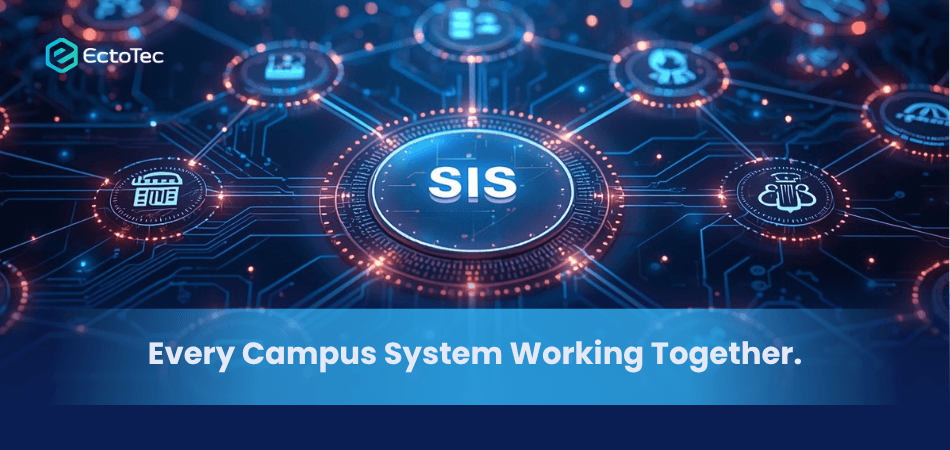
A single application does not constitute a cohesive digital campus. The Student Information System (SIS), Learning Management System (LMS), finance, communication, and student support platforms all function on the same integrated foundation in this interconnected ecosystem, where all university systems collaborate and exchange information with ease.
These core systems communicate in real time rather than operating independently. Every pertinent platform is instantly informed when a student's registration status changes. There is no manual syncing, no delays, and no data sitting in silos as grades, attendance, financial aid changes, and help requests move effortlessly between departments.
Everyone on campus has a single, uniform experience as a result. Faculty, staff, and students may access all of their resources with a single login, eliminating the need to switch between disparate tools. Every department, including student services, finance, and academics, operates using the same real-time data, which improves the institution's overall speed, intelligence, and connectivity.
The Real Cost of Disconnected Systems
In addition to being annoying, fragmented campus technology is costly. Staff productivity, student retention, and institutional compliance are just a few of the areas where the costs are evident, and they subtly increase each semester.
For administrative staff, disconnected systems require a never-ending amount of manual labor. Three systems are used by admissions staff to reenter application data. Enrollment records that ought to have been automatically synchronized are reconciled by registrars. Every week, IT staff spend hours changing passwords for sites that no one can monitor. According to research, these kinds of repetitive, manual operations account for between 60% and 80% of administrative time in higher education—work that integrated technologies would completely remove.
For students, the expense is significantly more severe. Imagine a real-world situation where a first-year student starts skipping assignments and losing interest in her classes. She emails the student support team directly, communicates with her professor via the LMS, and brings up a problem with the financial aid office via a different portal. No one on campus has the complete picture because none of these systems are connected. The warning indicators are ignored. She had withdrawn at the end of the semester, not because the institution didn't have the resources to assist her, but rather because those resources were unaware that she required assistance in the first place.
For the institution, the dangers are even more profound. Compliance reporting is an expensive and time-consuming process due to disconnected data. Audit trails lose their credibility. On the basis of little information, leadership makes strategic decisions. Additionally, disjointed data introduce risks that integrated systems would have avoided from the beginning when accreditation bodies knock.
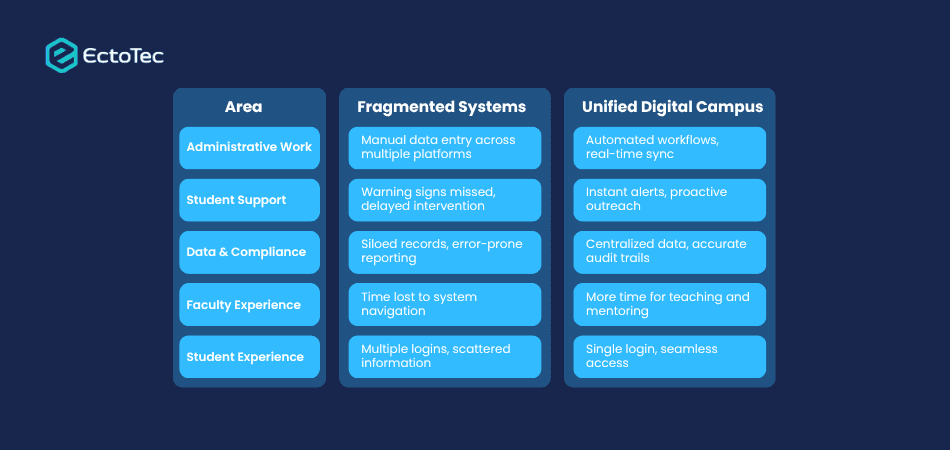
The cost of remaining dispersed is not a one-time annoyance. Every area of the university is impacted by this ongoing expense, which increases with each year that the issue is not resolved. .
What Students and Faculty Expect in 2026?
Students come to college in 2026 with expectations molded by years of using responsive, user-friendly digital systems. They want technology to be easy, quick, and customized, not something they have to struggle with to finish simple schoolwork.
However, a lot of universities still need students to use a variety of disjointed portals for daily tasks. A separate login and system are needed for checking grades, turning in assignments, getting financial information, and scheduling an advising session. This discrepancy between expectations and reality leads to frustration, which subtly undermines students' trust in the school from the start.
Expectations among faculty members have also changed dramatically. Instead of manually updating grades across platforms or looking for dispersed student data, professors and academic staff prefer to concentrate on teaching, mentoring, and research. Productivity and job satisfaction suffer in ways that are hard to recover from when technology increases friction rather than reduces it.
For universities, the stakes are high. Today's students are actively contrasting their digital experiences with those of other universities. The choice becomes simple if a rival provides a more seamless and integrated experience. Universities that don't live up to these changing standards run the danger of losing faculty and students to schools that just make things simpler.
Conclusion: The Unified Campus Is No Longer Optional
The universities that will take the lead in the upcoming years won't necessarily be those with the biggest resources or facilities, but rather those that make more intelligent choices about how their systems interact.
By 2026, a unified digital campus will be a need rather than an ideal. Students anticipate easy access. Teachers anticipate less administrative work. To make wise judgments, institutions need accurate, up-to-date data. Systems that are fragmented cannot reliably produce these results.
Making the strategic choice to stop viewing campus technology as discrete tools and start developing it as a cohesive ecosystem is the first step in the gradual shift to a single digital campus. Every semester that is delayed is a lost chance for higher student results, more productivity, and enhanced institutional performance.The success of this transition depends on the choice of technology partner for colleges that are prepared to do it.