




6 min read
Still Waiting on Reports? Why Real-Time Academic Alerts Are the Future of LMS



Introduction: The Reporting Lag That's Costing Students
Nowadays, universities have access to enormous volumes of student data, yet this data seldom results in prompt assistance. The majority of schools continue to use recurring reporting cycles, evaluating student achievement at midterm or semester-end intervals. The insights contained in these reports are already out of date by the time they are completed. It's possible that a student who started disconnecting in week three won't be noticed until week twelve, and by then, the opportunity for effective intervention has frequently closed.
This is the institutional visibility gap in higher education. It can take weeks or even a whole semester for an institution to become aware of a student's declining tendency. Missed assignments, dwindling engagement, and decreased login activity are examples of controllable academic risks that subtly escalate into academic failure or dropout. In addition to slowing reaction times, traditional LMS reporting causes an internal delay that reduces the likelihood of early intervention.
Why Traditional LMS Reporting Is Falling Behind?
Traditional LMS reporting was created for a different era when it was thought to be sufficient to monitor course completion and grade submissions. These days, these systems are less of a stimulant for student success and more of a tool for maintaining static information. Their primary flaw is that they just document what happened, not why it happened or what is likely to happen next. Because this backward-looking approach prioritizes administrative compliance above practical understanding, faculty and advisors are left with data that depicts the past but offers little counsel for the present.
This type has a high operating cost. Advisors manually extract reports, cross-reference spreadsheets, and locate information that ought to be easily accessible, all of which take up important time. Imagine an academic adviser who oversees 200 students and spends every Monday morning going over LMS activity logs to determine which individuals require a check-in call. This time may be better used to assist those students. When a failing student is found via this method, the situation has frequently already worsened to the point where it could have been avoided.
Feature Comparison: Traditional LMS Reporting vs Real-Time Academic Alerts
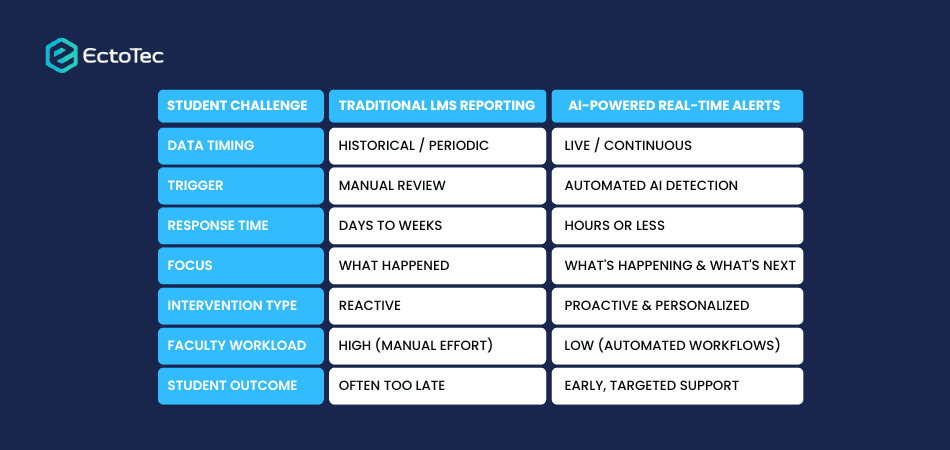
What Real-Time Academic Alerts Actually Do
Real-time alerts driven by AI drastically alter how educational institutions handle student difficulties, moving away from periodic assessment and toward ongoing academic intelligence. An AI-powered LMS continuously tracks behavioral and academic signals like login frequency, assignments activity, quiz performance, content engagement, attendance trends, and interaction abnormalities rather than waiting for a failing exam or missing semester report.
The technology immediately notifies the appropriate instructor or advisor when a student's conduct deviates from their typical learning pattern, frequently weeks before the problem becomes serious.
Context is just as important to these signals' effectiveness as speed. Instead of receiving raw data, faculty members receive actionable insights, such as about who is at risk, what caused the alert, and what kind of intervention could be necessary. For instance, the technology can automatically identify a major reduction in a student's involvement over a two-week period and alert advising teams and faculty, allowing for prompt academic intervention before performance deteriorates much further.
From Insight to Action: How Institutions Are Using Alerts Today
The benefits of switching from monthly reporting to real-time academic notifications are already being shown by forward-thinking universities. Institutions are developing early warning systems that allow proactive action as soon as a risk pattern emerges by fusing faculty insights with automated LMS data, such as attendance patterns, engagement levels, and grade trajectories.
Monthly reports are no longer a requirement for advisors. Rather, they receive real-time, prioritized alerts that specify which children require attention, how they are at risk, and the urgency of the need for intervention.
The impact on operations is substantial. The manual procedures that used to hold down student services are being replaced with automated outreach workflows, advisor escalation systems, and individualized academic assistance programs. Response times and student retention are starting to improve in schools using AI-powered alert systems, and at-risk children are getting help before problems become serious obstacles.
Not only does this lead to quicker action, but it also creates a more responsive learning environment where student success is no longer a delayed reaction but rather an active, ongoing process.
The Future of LMS Is Proactive, Not Periodic
Higher education institutions no longer need to ask whether real-time academic alerts are effective because their practical results already show their worth. How long can institutions rely on report cycles that repeatedly arrive too late? That is the true question.
Every semester that students spend waiting on out-of-date reports is a further term in which students slip through avoidable gaps and avoidable academic hazards.
The LMS of the future is not a better report; rather, it is a smarter, always-on system that anticipates problems, responds quickly, and gives teachers the ability to assist students when they need it. In addition to improving retention rates, institutions that switch from periodic reporting to AI-powered real-time academic intelligence will create more adaptable, data-driven learning environments going forward.
Institutions that place a high priority on real-time academic ability will be better positioned to increase student success at scale as higher education continues to transition toward AI-driven operations. This is because they will be able to put insight into action at the critical moment.