




6 min read
Beyond Grades: How Predictive AI Analytics in LMS Helps Prevent Student Dropouts


Why Grades Alone Are No Longer Enough:
Scores have long been seen as the primary measure of student achievement, but they often provide a limited view of the learning process. Instead of serving as predictors of potential challenges, they reflect past performance, which can mean that opportunities for timely support have already passed by the time low grades appear.
Focusing solely on grades can also harm students' intrinsic motivation. Learners who fixate on grades might find themselves less engaged, less creative, and less curious about the topics they are studying. By incorporating formal feedback, peer and self-evaluation, and reflective practices into learning, we can shift the focus from grades to genuine understanding, which in turn can reduce stress, foster independence, and enhance communication skills.
For example, a university discovered that when self-assessment was integrated into a writing course, students began to take greater ownership of their learning journey. Engagement rose, assignments became more deliberate, and teachers were able to spot troubled pupils before their grades showed a problem.In the end, grades by themselves are insufficient. Predictive AI in LMS can give institutions deeper, real-time insights that capture behavior, engagement, and risk.
What Is Predictive AI Analytics in LMS?
Predictive AI analytics leverages statistical methods and machine learning to analyze both current and historical student data to forecast potential outcomes. Within a Learning Management System (LMS), it identifies trends in student behavior, engagement, and academic performance, helping to pinpoint those who may be at risk of dropping out.
By examining extensive datasets—including login activity, assignment completions, participation in discussions, and quiz results—AI can reveal early indicators that grades alone might miss. For example, a student who consistently logs in but seldom engages in conversations could be identified for additional support, even if their grades appear to be fine.
Predictive AI, founded on data science, converts raw LMS data into meaningful insights, allowing educators to take action proactively, provide individualized instruction, and ultimately enhance student retention. Predictive AI enables quick interventions to keep students on track by transforming raw LMS data into useful knowledge.
Key Indicators AI Uses to Predict Dropouts
Predictive AI in Learning Management Systems (LMS) takes a deep dive beyond just grades. It looks closely at detailed behavioral and academic data to pinpoint students who might be at risk of dropping out. By combining historical performance with online activity—like how often students log in, what content they access, when they post assignments, and their involvement in discussions—we can uncover engagement patterns that traditional metrics often miss.
Observing behavioral trends, such as how often students interact with course materials or collaborate with their peers, can serve as strong indicators of future success. For instance, a student who consistently logs in but seldom submits assignments or engages in discussions might be flagged as at risk, despite having decent grades.
To make these insights actionable, institutions can map specific behavioral patterns to risk levels and corresponding interventions. The table below highlights some of the most important indicators and how educators can respond.
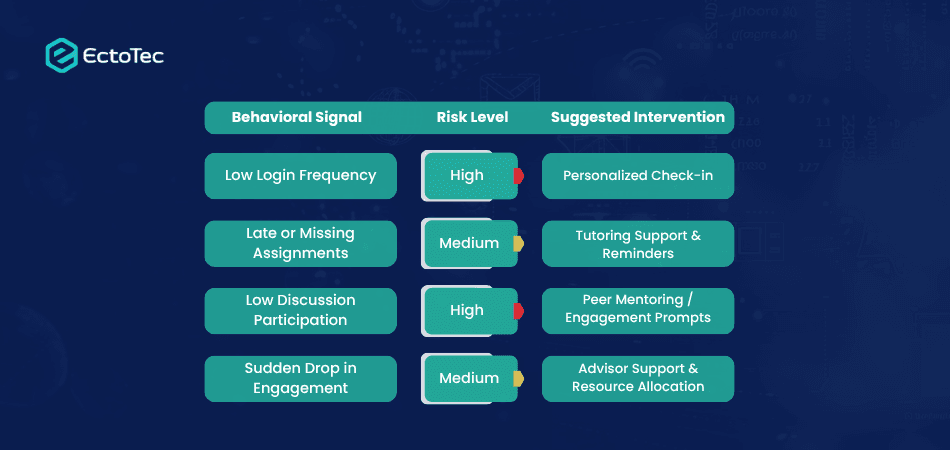
To enhance precision, educational institutions often utilize ensemble models that merge various predictive algorithms. This approach helps capture the wide range of student behaviors across different courses, semesters, and programs. The resulting insights are comprehensive, enabling instructors to take proactive measures in supporting their students.
Additionally, AI systems leverage demographic and academic data to generate customized recommendations for individual students. These may include suggestions for extra resources, personalized check-ins, or opportunities for peer mentorship, ultimately increasing the chances of academic success.
How LMS with AI Prevents Dropouts
An AI-powered learning management system serves as an early warning tool, identifying students who are at risk of dropping out even before final grades are released. By examining behavioral, academic, and engagement data, it enables educators to take proactive measures. For example, if patterns reveal that a student is submitting fewer assignments, becoming less active in discussions, or showing a significant drop in engagement, instructors can respond accordingly.
Interventions can be customized to meet individual needs; for instance, a first-year student struggling with time management might receive reminders to concentrate on upcoming assignments, while another student with lower engagement could benefit from being paired with a peer mentor to enhance participation.
Additionally, real-time alerts provide teachers and advisors with valuable information, allowing them to direct their support more effectively. LMS with AI transforms predictive data into tangible actions that enhance retention and keep students on course by combining early detection, customized interventions, and timely notifications.

Benefits for Institutions
AI-powered learning management systems (LMS) equip educational institutions with valuable insights that extend beyond mere grades, facilitating targeted support and timely interventions. By analyzing data on attendance, engagement, and academic performance, schools can pinpoint students who may be facing difficulties and swiftly take action to enhance their educational experience. Studies show that using predictive analytics has led to a 15% increase in retention rates.
These insights allow for the creation of tailored support programs that cater to the specific challenges of each student, providing additional resources, counseling, or instructional help. This data-driven strategy not only boosts the overall effectiveness of the institution but also enhances the outcomes for individual students.
By consistently collecting, analyzing, and utilizing learning data, organizations gain the ability to:
Improve retention
Enhance student outcomes
Make informed, strategic decisions based on real-time insights
An AI-powered LMS transforms raw data into a competitive advantage. It helps institutions create a supportive educational environment and leads to significant improvements in student achievement.
Conclusion
The future of higher education relies on proactive, data-driven initiatives. Predictive AI in learning management systems allows institutions to move beyond reactive measures. It helps identify at-risk students early and provides personalized help before disengagement worsens.
AI is no longer a luxury; it is a necessity in today's learning environments. Schools can use behavioral, engagement, and academic data to improve retention, enhance student outcomes, and create a learning environment that supports each student’s success.
Using predictive analytics makes sure that interventions are timely, informed, and effective. This approach helps institutions foster a culture where students stay on track, engaged, and empowered to reach their full potential