




6 min read
Modernizing Higher Education: How AI-Driven SIS Automation Improves Efficiency and Data Accuracy


Introduction: The Need to Modernize Institutional Systems
In the fast-evolving landscape of higher education, administrators must find a way to balance operational efficiency with the delivery of quality experiences for students. Student Information Systems (SIS) act as the unseen foundation, streamlining processes and facilitating improved decision-making across various departments.
Numerous organizations are still dependent on obsolete technology and manual processes, leading to workflow delays, a rise in errors, and security vulnerabilities. Meeting data privacy regulations can be difficult, and typical administrative tasks are susceptible to mistakes or fraud.
Automation of SIS with AI addresses these problems by accelerating workflows and ensuring data accuracy. At one medium-sized university, the implementation of AI-powered SIS automation resulted in a 40% reduction in registration errors and a 30% decrease in reporting time.
The Operational Challenges Within Traditional SIS Environments
Numerous colleges still depend on outdated systems and manual processes, which create significant operational challenges. The labor-intensive tasks of documenting grades, calculating outcomes, and managing student records are prone to errors and consume a lot of time. Over time, data inconsistencies, like misspelled names, overlooked decimals, or format discrepancies, can build up, leading to incorrect reporting and unreliable analyses.
These inefficiencies drain employees' mental resources. Administrators spend countless hours on tedious, low-value tasks, leaving them with little opportunity for strategic work that could enhance student success. Obstacles in communication, scheduling, and recordkeeping hinder decision-making, frustrate teams, and increase the likelihood of compliance or security violations.
What AI-Driven SIS Automation Really Means
An AI-powered SIS is a complete platform that combines all administrative and student administration operations. From admissions and enrollment to grading, attendance, and financial administration, it eliminates data silos and offers a single source of truth for all student-related data. This connection enables data-driven decision-making, which aids institutions in developing more efficient, transparent, and modern digital campuses.
AI-driven automation also improves data accuracy as well as safety. Automated workflows incorporate safeguards such as human checkpoints for sensitive actions, strong passwords, and access controls to protect personal data. Clear guidelines and open communication guarantee that employees and students realize how data is maintained, avoiding errors and compliance concerns.
In addition to improving operational efficiency, AI-powered SIS can forecast enrollment patterns, enhance outreach, encourage student retention, and narrow enrollment gaps through statistical analysis. Colleges can quickly adjust to changing requirements thanks to real-time updates across numerous platforms
Improving Efficiency Across Campus Operations
AI-powered SIS automation streamlines campus operations by replacing repetitive human processes with organized, rule-based workflows. Admissions, evaluation, scheduling, and accounting operations become more efficient, accurate, and transparent.
Admissions automation alone provides considerable benefits. By decreasing manual intervention, institutions can save hundreds of hours per admissions cycle while increasing offer effectiveness and student engagement. Cost savings are generated as automation eliminates the need for additional workers during peak periods, allowing teams to focus on key projects.
Automating report production and alerting improves decision-making. Automated grading updates guarantee that professors always have the most recent results, and scheduled reminders alert students to deadlines and crucial events. AI-powered dashboards give real-time analytics, increasing campus agility and efficiency.
Strengthening Data Accuracy and Governance
AI-driven SIS automation ensures that university data is accurate, consistent, and dependable. Normalizing data across systems avoids duplicates and improves efficiency from application to graduation. Automated validation procedures prevent errors from propagating, and compliance-ready reporting ensures that institutions satisfy regulatory standards. Centralized dashboards give administrators real-time analytics to help them make strategic decisions.
Key Impacts of AI-driven SIS Automation Include:
Removes student records that are duplicated across departments.
Automatically detects errors in applications and records.
Increases reporting accuracy by 35%, allowing staff to focus on student retention and involvement.
Application processing, finances, and student services are all integrated to provide seamless operations.
From Automation to Strategic Insight
Integrating AI into SIS does more than improve operational efficiency; it provides university executives with meaningful data for strategic decision-making. By evaluating institutional data, AI solutions empower administrators to make more accurate, regular, and timely enrollment, retention, and resource planning decisions.
AI-driven systems use prescriptive as well as predictive analytics to assist universities maximize enrollment yield and student retention. Universities can identify prospective students who are most likely to enroll, forecast trends to better allocate resources, and discover early signs of detachment to intervene before academic performance begins to decline.
This technique enables institutions to shift from reactive administration to proactive strategy, improving student results and institutional performance.
Key Considerations for Implementation
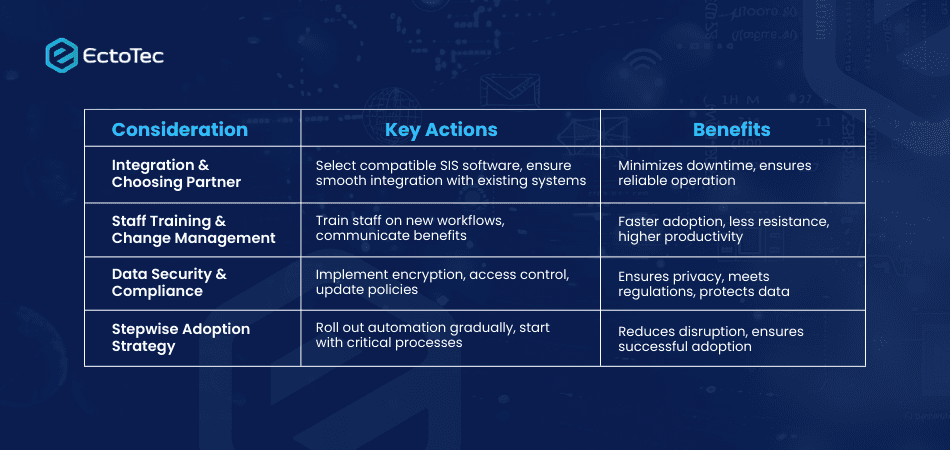
To maximize benefits while avoiding frequent hazards, AI-driven SIS automation must be carefully planned and implemented. The best SIS software for 2026 controls grades and enrollments while also facilitating compliance, reporting, extensions, and long-term expansion.
Change management is crucial as universities navigate the changing AI world. Employees must comprehend new workflows, and firms must implement strategies to remain competitive while being resilient.
A clearly defined data protection policy assures compliance and security. Policies should specify how data is gathered, kept, maintained, and who is accountable. Regular updates, personnel training, and governance supervision ensure that implementation remains consistent.
A progressive adoption plan enables institutions to gradually introduce automation, prioritizing high-impact procedures first, thus decreasing disruption and guaranteeing seamless integration with current systems.
To simplify these key considerations, the following table outlines the main areas universities should focus on, along with actionable steps and the benefits of each approach:
Conclusion: Building the Modern Digital Campus
A modern AI-driven SIS is more than simply an administrative tool; it's a strategic asset that enables universities to run more efficiently, make data-driven choices, and improve the overall student experience. By automating monotonous processes, enhancing data accuracy, and delivering predictive insights, SIS solutions allow employees to focus on high-value projects such as enrollment optimization and student engagement.
Universities that implement AI-powered SIS automation can see demonstrable gains in operational efficiency, governance of data, and institutional performance. Leaders who promote digitization and invest in integrated and intelligent technologies are better positioned to negotiate the complexity of higher education while cultivating an environment of creativity and continual improvement.
Adopting AI-driven SIS solutions is more than simply a technology improvement; it's a step toward converting campuses into flexible, digitally-enabled environments ready to face today's and future issues.