



6 min read
Engagement Overload? How AI Automation in LMS Keeps Students On Track Without Micromanaging



Introduction: The Cost of Too Much — Why Student Engagement Is Breaking Down
Students' learning, engagement, and success in higher education are changing due to the emergence of Generative Artificial Intelligence (GenAI). Today's universities have greater digital connectivity than in the past. In order to enhance academic results, they use Learning Management solutions (LMS), analytics platforms, methods of communication, and AI-powered student participation solutions.
However, student disengagement is still increasing in spite of this technical advancement. In 2026, higher education will face this engagement paradox.
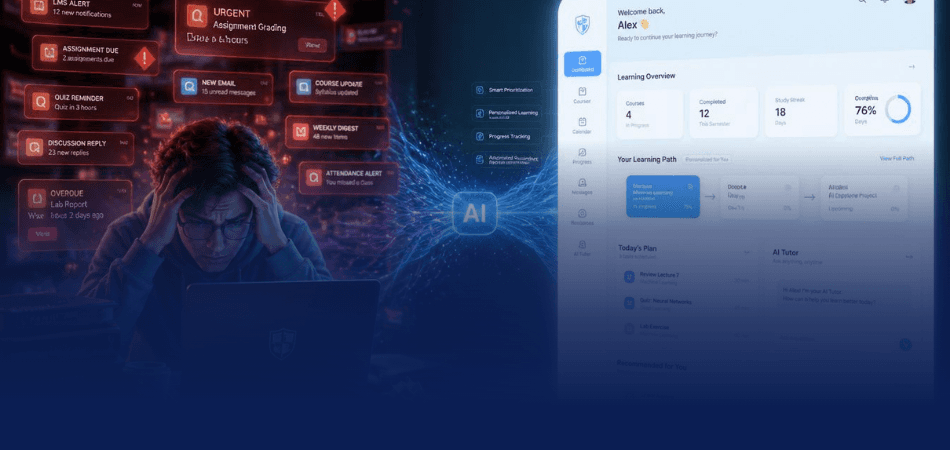
Despite having continuous access to learning materials, alerts, homework, reminders, discussion boards, and communication channels, many students feel overburdened rather than supported. What was intended to increase participation is increasingly causing digital weariness, with 77% of students reporting anxiety and 60% reporting burnout. Lack of technology is not the problem. The usage of technology is the problem.
By processing too much, connecting too frequently, and tracking every student encounter without a clear aim, many universities unintentionally generate digital pressure. As a result, learning feels impersonal, reactive, and draining.
Universities now need to consider how to incorporate AI automation into their LMS in a way that maintains students on task without addition to the noise, rather than whether or not to do so. Instead of doing more, the solution is to do it more intelligently.
What "Micromanaging" Looks Like in a Digital Learning Environment
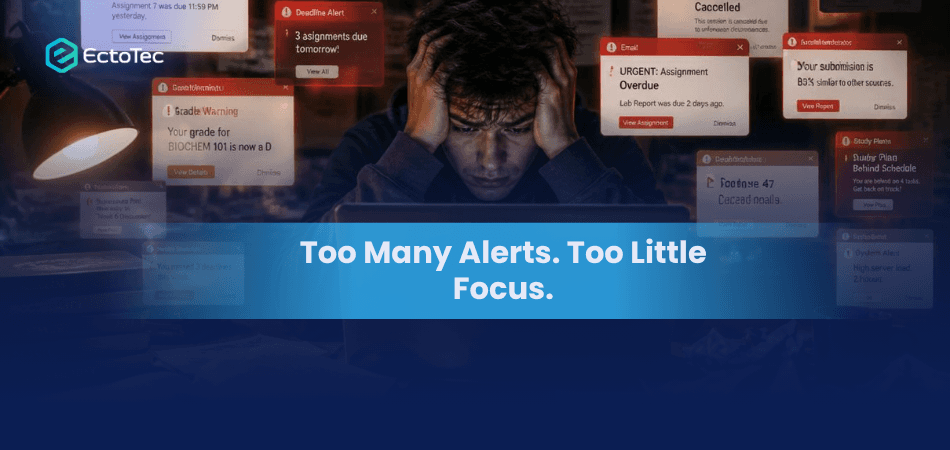
Micromanagement no longer resembles a professor watching over an individual's shoulder in today's educational environment. It now appears to be an LMS that is always requesting care. Deadline notifications, grade notifications, attendance alerts, activity monitoring updates, and disjointed communications across many platforms are all constantly sent to students. This constant barrage of information frequently leads to stress rather than assistance.
Before the first lecture of the week, picture a first-year university student opening their LMS on a Monday morning and seeing four assignments reminders, two automated grade alerts, low activity notices, and numerous unread faculty messages. Anxiety has already infiltrated the learning process before the day has even started.
As a result, instead of concentrating on meaningful learning, students waste more time handling notifications. Over-automation leads to silent disengagement and emotional tiredness rather than increased participation. Students tune out because the framework makes caring seem overwhelming, not because they stop caring.
The technology itself was never the issue. Using automation without strategy—deploying all available tools at maximum volume and hope something sticks—is the issue.
Where AI Automation Actually Fits In — And Where It Doesn't
Not every automation enhances the learning environment. One factor distinguishes beneficial AI from detrimental automation: intention. In an AI-powered learning management system, intelligent AI automation operates silently in the background, making choices and modifications ensuring that pupils hardly notice but regularly profit from. On the other hand, ineffective automation continuously disrupts students with pointless warnings and generic communications that add noise instead of value.
Instead of increasing friction, the finest AI systems are designed to reduce it. AI performs well in domains that students are not aware of, like identifying retention risks early on, spotting involvement trends before a student realizes they are falling behind, adjusting instructional methods based on performance, recommending customized resources, and giving faculty and advisors intervention insights at the ideal moment.
Excessive student surveillance and emotionally detached communication are two areas where AI has no place. Overwhelming students with alerts, recording every student action needlessly, or sending automatic warnings without context don't increase participation; instead, they undermine confidence. When a student is progressively losing interest, a well-designed AI-powered learning management system (LMS) detects it and reacts by subtly suggesting relevant information, adjusting the difficulty of upcoming material, and discreetly alerting advisors—all without ever making the student feel watched.
AI is not intended to take the role of humans in higher education. The goal is to safeguard it by having intelligent technologies take care of the routine, allowing meaningful human support to occur for the appropriate student at the right moment with the correct information.
How AI Automation in LMS Works Quietly — Keeping Students On Track Without the Pressure
Students rarely notice the most potent AI systems. Without interfering with the student experience, contemporary AI-powered platforms for learning management systems can evaluate learning behavior, spot academic gaps, and customize learning paths. These systems operate proactively, making adjustments and providing real-time help before an individual ever reaches a crisis point, as opposed to responding to issues after they have already gotten worse.
For instance, if a student consistently struggles with an idea during weekly evaluations, an intelligent learning management system (LMS) can suggest more learning materials, modify the pace of the content, and discreetly alert instructors—all without sending the student a single alarming notification. The instructor stays informed without having to go over each submission by hand, and the student is supported without feeling watched.
Here is what that shift looks like in practice:
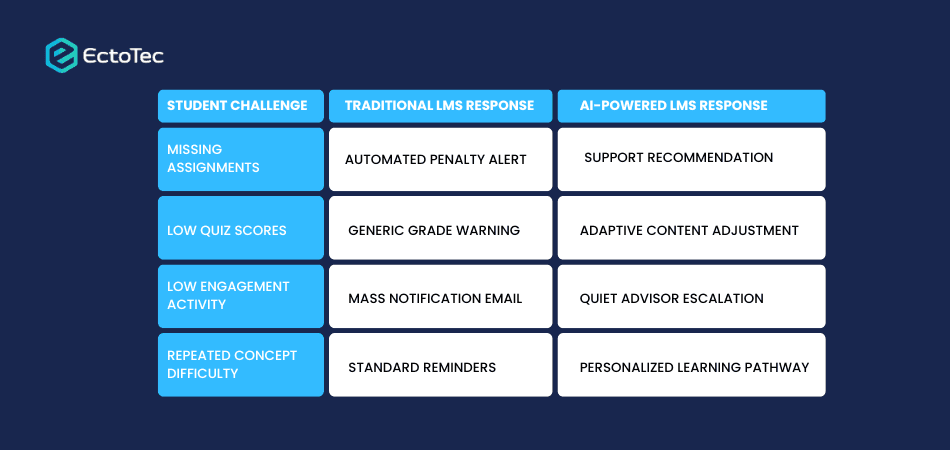
This is where AI truly shines—not by applying more pressure, but by enhancing the promptness, customization, and caliber of assistance. Because the method feels encouraging rather than reactive, students remain involved. However, AI should never take the role of human learning, critical thinking, or academic responsibility; rather, it should always be used as a supporting tool. Students still need to actively participate in their education, analyze material on their own, and contribute significantly. AI eliminates friction. Effort should never be eliminated.
The Role of Faculty — AI as a Support, Not a Replacement\
Teaching, grading, reporting, communication between students, and administrative duties are already balanced by faculty members. Without the proper resources, the operational burden of contemporary academic life directly contributes to burnout. By managing time-consuming chores without needing in-depth human judgment, AI automation helps lessen that strain.
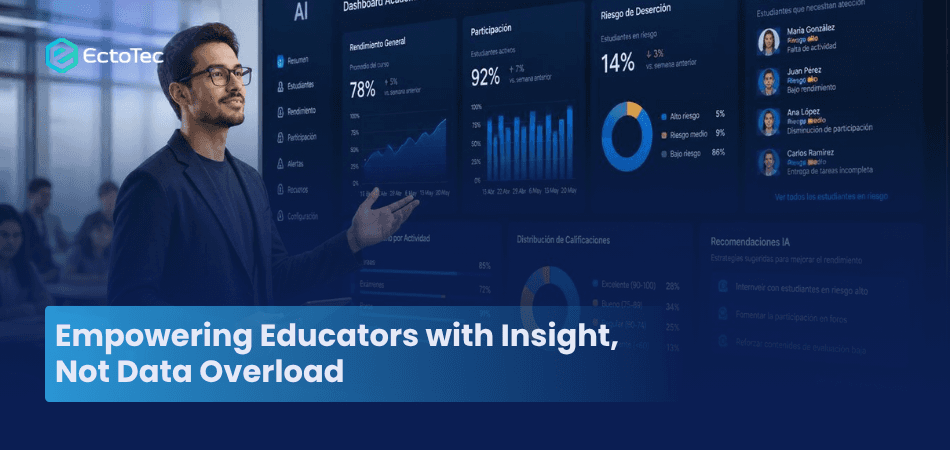
Intelligent LMS workflows can streamline follow-up reminders, progress tracking, participation monitoring, repetitive grading, and retention risk assessment. An AI-powered LMS, for instance, can instantly display prioritized intervention insights, allowing advisors to know precisely who needs attention and when without spending hours sifting through raw data, as opposed to manually analyzing hundreds of student records to discover who could be lagging behind.
The role of academics is not diminished by this. It makes it stronger. Teachers can focus their efforts where it really counts—mentorship, individualized academic advice, and the kind of meaningful human engagement that no algorithm can duplicate—when repetitious operational responsibilities are taken off their plates. Ten automated reminder emails will never have the same impact as a brief, sincere meeting between an advisor and a struggling student.
As a result, there is a more positive academic atmosphere where advisors are better able to make quicker, more educated decisions, faculty members are less burned out, and students feel truly supported. AI gives educators the time and clarity they need to accomplish their best work; it does not replace them.
Real Results — What Universities Are Seeing
It is no longer theoretical for LMS platforms to go toward AI automation. Measurable gains in faculty productivity, engagement, and retention have already been reported by universities using intelligent engagement systems.
By detecting disengagement tendencies earlier and facilitating quicker, more focused intervention, schools utilizing AI-driven systems for early warning have reported better student retention results. AI can identify what used to take advisers weeks to manually identify in a matter of days or even hours, providing institutions with a significant window of opportunity to take action before a student completely disengages.
Academic consistency, course attendance, assignment completion rates, and general student engagement are all improving at universities using adaptive learning workflows within their AI-powered LMS ecosystems. Students do better because the material meets them where they are and support is provided before they need to ask for it, rather than because they are being pushed harder.
Faculty members are equally affected operationally. Teachers can now devote more of their time to mentoring and academic support instead of spending a lot of time on administration reporting and manual intervention tracking. Instead of fragmented data dispersed across numerous disjointed platforms, advisors obtain clearer, more actionable insights. As a result, there is a more intelligent academic ecosystem in which institutions increase retention rates more effectively, staff keep focused on teaching, and students stay engaged for longer. Everyone gains when AI operates intelligently in the background.
Conclusion — The Future of Student Engagement Is Quiet, Smart, and Effective
Overwhelming digital workflows, constant notifications, and intrusive monitoring will not be the foundation of student engagement in the future. It will be based on sophisticated systems that know when to step in, how to help pupils, and when to just go aside.
Carefully using AI at universities will not just increase operational effectiveness. They will establish more wholesome learning environments where teachers feel empowered, students feel truly supported, and technology helps people rather than wears them out. Stronger retention results, better faculty workflows, increased engagement, and more engaging student experiences are being observed by the schools already spearheading this change.
The path ahead is obvious. Instead of automating everything, start automating wisely. Let AI take care of the operational, repetitive, and routine tasks so teachers can concentrate on the most important aspect of learning—the human element.
The goal of higher learning has always been to transform people. Today's students want a system that believes in them, not one that keeps an eye on them. When AI automation is used properly, institutions may fulfill that promise on a large scale.