



6 min read
The Hidden Cost of Legacy SIS: Strengthening Higher Ed System Security and Student Satisfaction with AI Modernization



Security Challenges in Legacy SIS Systems
Because of their antiquated and inflexible architectures, legacy student information systems (SIS) pose significant security vulnerabilities to higher education institutions. Modern security frameworks like multiple authentication methods (MFA), encryption requirements, and real-time threat tracking are absent from many of these systems, which run on monolith or flat network architectures.
The fact that many colleges still use old SIS without active support from vendors raises serious concerns since it leaves important vulnerabilities unpatched. As a result, institutions are vulnerable to malware assaults and illegal access, and an increasing proportion of data security breaches in higher education are caused by outmoded systems.
These systems also have trouble adhering to contemporary compliance standards like GDPR and HIPAA, which raises the possibility of legal infractions and data disclosure. IT teams find it challenging to recognize and effectively address problems in the absence of enhanced threat detection and real-time monitoring.
Important student and institution data are therefore still extremely susceptible, underscoring the pressing need for cloud-based, AI-driven SIS modernization to improve security architecture.
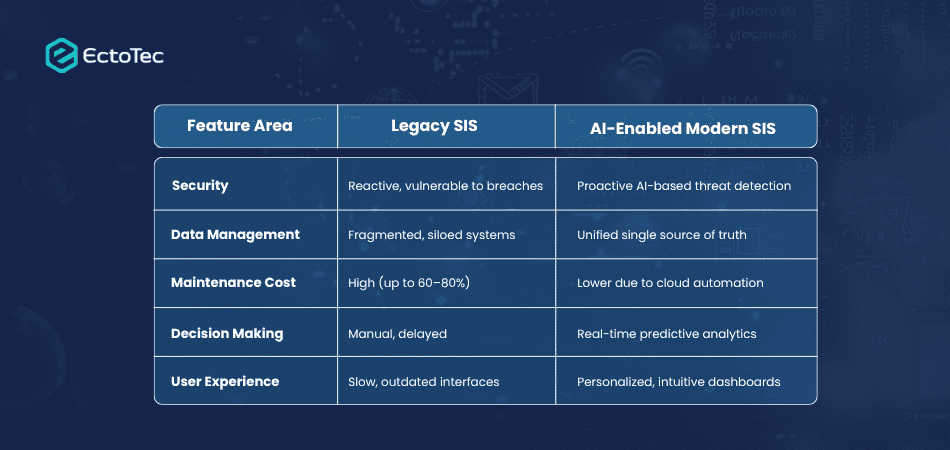
Legacy SIS vs. Modern AI SIS: A Comparison
The table below highlights the key differences between legacy SIS platforms and modern AI-enabled systems across critical operational areas:
Operational Inefficiencies in Campus IT Systems
Outdated manual workflows and disjointed technological environments are common causes of operational inefficiency in higher education organizations. Administrative teams are burdened by the fact that many campuses still employ paper-based records, compartmentalized systems, and drawn-out approval procedures.
These inefficiencies put a heavy burden on institutional resources, resulting in increased operating expenses, employee burnout, and delays in important administrative and academic tasks including student support services, admissions, and grading. Additionally, uneven data flow from a lack of the system integration makes it challenging for academic and IT departments to work together.
Institutions thus experience decreased productivity and delayed service delivery, which has a direct effect on employee performance and the educational experience for students. It is now crucial to modernize traditional procedures through digital transformation, such as cloud-based platforms and automated workflows, in order to increase productivity and free up institutions to concentrate on academic excellence and student achievement.
Impact of Legacy SIS on Student Satisfaction
Higher education institutions' entire student experience is greatly impacted by legacy student information systems. Students commonly experience delays in accessing crucial services like course enrollment, grade updates, record of attendance, and academic support because these systems are frequently inefficient, antiquated, and difficult to use.
Students become frustrated when they have to travel several disconnected platforms for simple academic work because of the system's poor responsiveness and interface design. During busy times like enrollment, students in many institutions that use legacy SIS find system issues or delays in getting updated academic information.
Student engagement and happiness are directly impacted by this disjointed and ineffective experience. Students' attention is diverted from studying and general academic engagement when they have trouble with administrative procedures, which can eventually impact retention and performance.
The need for smooth, real-time, and user-friendly technologies keeps rising as higher learning becomes more focused on the needs of its students. These demands can no longer be met by legacy SIS platforms, which emphasizes the need for contemporary, experience-driven solutions.
How AI SIS Modernization Transforms Higher Education Systems
Institutions are increasingly implementing AI-powered SIS modernization initiatives to solve these issues. These systems replace manual, reactive procedures with intelligent, proactive workflows that improve productivity and decision-making.
High-volume administrative chores including reporting, tracking attendance, and processing enrollments are automated by AI-enabled SIS technologies. By reducing human error and freeing up staff time for more strategic academic support tasks, solutions like Camu and Academia ERP improve service delivery and efficiency.
Additionally, by serving as a consolidated data hub among departments, contemporary systems do away with data silos. Academic, administrative duties, and financial systems automatically synchronize updated student data, guaranteeing consistency and minimizing delays.
Predictive analytics further enhances institutional performance by identifying patterns in student behavior and performance. This enables early intervention for at-risk students, improving retention outcomes and fostering improved decision-making.
Ultimately, incorporating AI improves the digital environment's responsiveness and usability, allowing institutions to boost overall performance and offer more academic support.
Strengthening Higher Ed System Security with AI
By enabling proactive, ongoing, and intelligent protection measures, AI is revolutionizing the security of higher education. AI-powered platforms are able to identify and react to complex risks in real time, in contrast to legacy settings that depend on static security rules.
Institutions can detect anomalous system behavior that can point to ransomware attacks, phishing attempts, or unauthorized access by using machine learning-based anomaly detection. For instance, the system can quickly flag or restrict activity if a user tries to access private information outside of typical usage patterns.
By automating monitoring procedures and guaranteeing compliance with privacy and data protection laws, AI also improves compliance management. This increases accuracy and consistency while lessening the workload for IT teams.
Furthermore, AI-driven access management systems greatly reduce human mistake, which is a major source of security flaws in traditional systems, by dynamically modifying permissions depending on user responsibilities and behavior.
AI-enabled SIS solutions are becoming crucial for protecting institutional data and preserving system integrity as online risks continue to change.
Campus IT Transformation with AI-Driven SIS
AI-enabled, cloud-native SIS platforms that replace disjointed legacy infrastructures are increasingly driving campus IT transformation. Through tailored, real-time information, this change enables schools to lower administrative expenses while increasing student retention.
Universities are creating cohesive and interoperable ecosystems by combining AI, cloud computing, and advanced analytics. These platforms facilitate quicker decision-making, easier departmental collaboration, and more effective academic operations.
By monitoring behavior and customizing digital interactions, AI also improves user experience. This enhances engagement and learning results by enabling schools to offer tailored recommendations for classes, materials, and support services.
Campus IT environments are therefore becoming proactive, adaptive ecosystems that facilitate independent operations and data-driven tactics. The groundwork for future-ready digitized campuses that prioritize effectiveness, customization, and scalability is being laid by this transition.
Conclusion: The Future of Intelligent SIS in Higher Education
Higher education institutions are facing risks from outdated student information systems. These systems lead to hidden costs related to security, operational efficiency, and student experience. These challenges prevent organizations from achieving true digital maturity. Data ecosystems remain disconnected, and threats to cybersecurity continue to grow.
Updating SIS with AI features provides a clear path forward. New technologies improve data security, reduce administrative burdens, and greatly enhance student satisfaction through automation, real-time analytics, and smart decision-making.
As higher education evolves, moving to cloud-based, AI-powered SIS platforms is essential. In a more digital academic world, institutions that embrace this change will be better positioned to offer safe, efficient, and personalized learning experiences, ensuring long-term success