




6 min read
From Alert to Action: How Universities Can Build AI-Powered Student Support Workflows That Actually Work



Introduction: The Gap Between Spotting a Struggling Student and Actually Helping Them
Universities are generating more information about students than ever before in today's fast-changing academic landscape. They track everything, including grade trends, login frequencies, attendance, and assignment submissions. Despite this wealth of data, thousands of students still fall through the cracks each semester. The real issue isn’t the lack of data; it’s the gap between recognizing that a student is struggling and taking quick, effective action to help them.
Tools like adaptive learning software, feedback systems, and AI-driven tutoring are already showing how technology can help students improve their performance. Without a smart process, a student who misses three assignments and stops logging into the learning management system may go unnoticed for weeks until it's too late to intervene. However, the biggest opportunity lies not in specific tools, but in creating smart, integrated workflows that connect early warning signals to real human responses.
Educational institutions need to understand that new technologies should support teachers, not replace them. AI is most effective when it empowers teachers to customize their teaching, refine feedback, and focus on what truly matters. With timely, data-supported alerts about disengaged students, faculty can respond with confidence rather than guesswork.
Universities willing to close this gap can start right away by designing workflows that translate data into action, automating routine administrative tasks, and exploring AI-enhanced assessments that evaluate critical thinking instead of rote memorization. The schools that will excel in student success are not necessarily those with the most data, but those that know how to use it effectively.
Why Alerts Alone Aren't Enough — The Missing Piece Is a Structured Workflow
Most institutions have some form of early warning system, but having warnings doesn’t mean there’s a plan. In reality, many alerts go ignored. Students often know they are struggling, and they may be trying to improve or have already lost interest. A simple automated notice does not change anything.
There's a larger issue with communication. Students receive so many emails and messages from their institutions that it can become overwhelming. They tune out communication that feels random or insincere, causing important alerts to get lost in the noise. Picture an at-risk student receiving their sixth automated email of the week without a clear next step or a personal touch—it's very likely that they won't read it.
The real missing piece is structure. There’s no clear process for who gets the warning, what actions they should take, and when. Without clear direction, even the best early detection system can become just another ignored alert. Without structure, there’s no action.
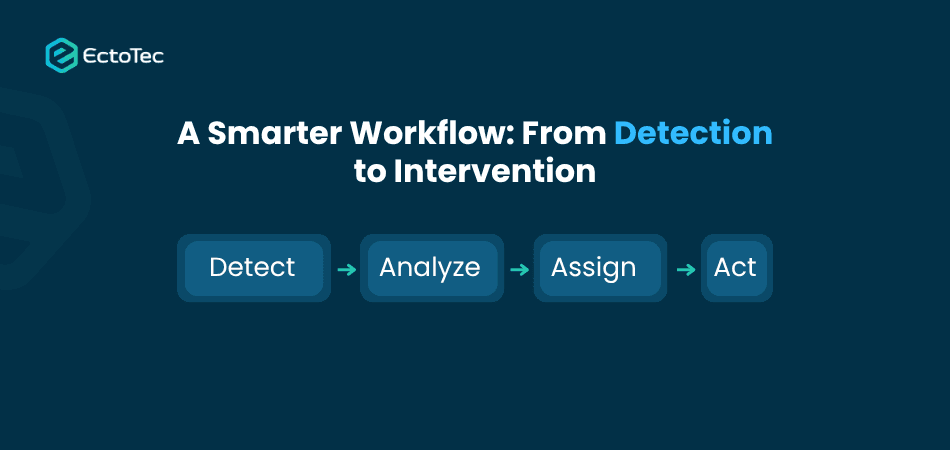
Institutions need a structured support pipeline where AI triggers alerts, assigns them to the right person, tracks follow-ups, and escalates issues if no action is taken. The aim is not to remove the human factor, but to ensure that the right person is informed at the right time with the right information for a meaningful conversation with the student.

How AI Builds the Bridge — From LMS Data to Automated Action Steps
The true power of AI in higher education lies in its ability to connect raw LMS data to actionable steps. AI quickly converts data insights into personalized content recommendations, targeted interventions for struggling students, and automated administrative workflows by analyzing student behavior trends in real time. This means no one has to sift through reports manually.
An AI-powered LMS is more than just a system for logging in and tracking assignment submissions. It actively automates processes, personalizes learning paths, and delivers data-driven insights to help institutions respond more quickly and intelligently. For instance, if a student consistently scores poorly on quizzes but never asks for help, an AI-powered LMS can automatically recommend additional resources, notify the instructor, and arrange a check-in with an advisor. All of this can happen within the same workflow without human input.
Here is what AI actually does inside a modern LMS:
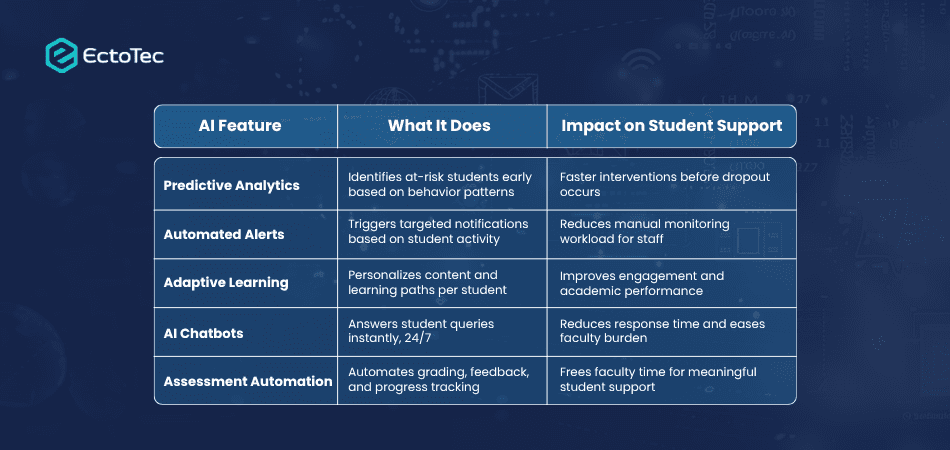
Large language model technology, a type of AI that excels at text recognition and generation, underpins these advances. This enables more sophisticated chatbots, better feedback systems, and communication tools that feel genuine. Together, these features transform the LMS from a passive content delivery platform into an intelligent support system that not only gathers data but knows how to apply it.
What a Next-Gen Support Workflow Looks Like — Step by Step
A fully connected, AI-driven, multi-channel system that provides timely, personalized, and proactive support for staff and students represents the next generation of student support workflows. It allows human advisors to focus on what really matters—complex academic challenges, meaningful student guidance, and mental health discussions—by taking care of routine tasks like password resets, form submissions, and enrollment inquiries.
Building this workflow follows a clear three-step process:
Step 1 — Identify your workflow.
From the time an alarm is set off until a student receives assistance, map out every contact in the student support journey. Determine the holes, hold-ups, and blockages in your present procedure.
For instance, a university might find that advisors take an average of 72 hours to respond to an alarm, which is much too long to stop a student from becoming even more disengaged.
Step 2 — Analyze your workflow.
Identify the areas where AI can be most beneficial. Which repetitious chores can be automated?
In what low-impact activities are advisers spending their time? Which pupils are routinely overlooked, and why? This analysis frequently shows that advisors spend a significant amount oftime on administration follow-ups rather than having direct, meaningful talks with students.
Step 3 — Implement the workflow.
With staff training integrated from the outset, include AI tools into your learning management system and SIS platforms to automate triggers, assign cases, track replies, and escalate unsolved issues. For example, an advisor who used to spend hours manually reviewing student progress reports may now efficiently prioritize their outreach by receiving a daily AI-generated summary that highlights only the individuals that want immediate attention.
A next-generation support workflow doesn't feel like a technological project when done correctly. It has the impression of a university that consistently shows up for its students.
Conclusion — It's Time to Move from Alert to Action
There is currently technology available to revolutionize student support. Predictive analytics, automated processes, intelligent chatbots, and AI-powered LMS systems are no longer futuristic ideas; they are readily available, tested, and prepared for deployment. The question of whether colleges can create more intelligent support systems is no longer relevant. When they will is the question.
Schools will continue to lose pupils they could have rescued if they keep using disjointed procedures and passive alert systems. Investing in organized, AI-driven processes will not only increase retention but also create a unique culture of proactive and student-centered assistance.
The way forward is obvious: find the gaps in your workflow, use AI to automate and link your support structures, and give your advisors and teachers the knowledge and resources they need to take action rather than just watch.
Technology can bridge the gap between identifying a problematic student and providing them with assistance. To build the bridge, all you need is the will.