




6 min read
Smarter Admissions: How AI-Powered SIS Transforms Student Enrollment from Chaos to Control



Introduction — The Admissions Chaos Problem at Scale
We are at a pivotal moment in higher education. Every academic cycle, the number of students seeking admission increases along with the growth of institutions throughout Latin America and beyond. What used to function seamlessly on email threads and spreadsheets has subtly turned into a crisis that goes unnoticed.
The conventional, manual method of handling admissions is just not able to keep up with the thousands of applications that colleges are currently getting each cycle. Applicants are kept waiting days or even weeks for a basic status report, staff members are buried beneath piles of paperwork, and disconnected tools are unable to communicate with one another. The outcome? Everyone's experience was disjointed and annoying.
The figures paint a striking picture. Following missing documents, manually revising applicant status, and re-entering data across several systems account for between 60% and 80% of the time spent by admissions staff on merely repetitive operations. Institutions are forced to choose between hiring more people at unsustainable prices or accepting dangerously sluggish turnaround times when application volumes surge during peak cycles.
The pandemonium of admissions in 2026 looks like this. Additionally, the ability to scale gap is only growing for universities that continue to use outdated procedures.
The good news? There is a better course of action, and it begins with reconsidering how technology facilitates the entire admissions process.
Why Traditional Admissions Processes Break Down
Admissions season feels more like an organized emergency than a well-organized procedure at many universities. The flaws in traditional workflows are evident everywhere since they were never designed for today's scale.
The majority of universities have independent systems for academic records, financial aid, registration, and admissions that don't communicate with one another. Staff end up manually re-entering the same data across multiple platforms, creating duplicate records, inconsistencies, and compliance risks that are expensive to fix. To make problems worse, certificates end up in various portals, transcripts arrive via email, and paper forms get lost on desks. Both parties lose time in this cycle as employees spend hours looking for missing papers while applicants impatiently wait for an update.
Burnout is inevitable when a fixed admissions crew processes thousands of applications by hand. Errors include incorrect data entry, late submissions, and missed eligibility flags that could have major repercussions later on rise with volume. Teams who are overworked have irregular status updates and delayed follow-up communications. After being kept in silence for days, applicants simply transfer to organizations with quicker and clearer communication.
Admissions administrators are compelled to make capacity and choices regarding resources based on out-of-date information in the absence of a real-time overview of application status, which raises the possibility of excess or under-enrollment. Additionally, manual record-keeping exposes institutions to needless regulatory risk by making it practically hard to maintain clear audit trails or confidently respond to accreditation evaluations.
Slow processing times are just one of these inefficiencies' costs. Institutions lose competent applicants, staff morale declines, and students have a negative first impression of the school. A better approach exists, and it begins with more intelligent technology.
What AI-Powered SIS Actually Does in Admissions
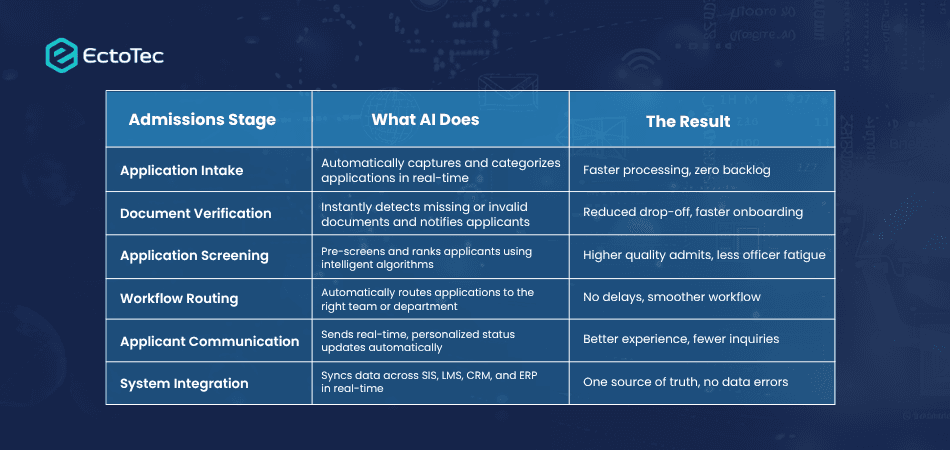
Admissions is transformed from a human bottleneck into a clever, automated operation by an AI-powered SIS. AI manages intake, assessment, routing, and communication as soon as an application is received—instantly and without weariness. Instead of taking the place of admissions officers, it relieves them of tedious duties so they can concentrate on what actually calls for human judgment.
Here is a description of each enrollment stage so you can see exactly where AI comes in and what it offers:
Predictive Enrollment Analytics: Knowing Who Will Enroll Before They Do
There is a big difference between accepting an applicant and getting them to enroll. Schools that use historical averages or gut instinct to forecast enrollment yield are frequently caught off guard, either over-prepared for students who never show up or under-resourced for those who do.
This is completely altered by predictive enrollment analytics. AI determines each potential student's likelihood-to-enroll score by examining past enrollment data, applicant behavior, trends in demographics, and engagement signals. This implies that admissions personnel are aware of which accepted students are actually likely to guarantee their spot before a selection is ever made.
For instance, a university can determine that candidates are far more likely to enroll if they open three or more emails, visit the campus portal several times, and apply for financial aid early.
Equipped with this knowledge, outreach teams can re-engage candidates who exhibit little involvement signals before it's too late and focus those students with tailored follow-ups.
Higher enrollment yield, more precise capacity planning, and more intelligent resource allocation are the outcomes, all without adding to the workload of admissions staff.
From Manual to Automated: Real Efficiency Gains
Converting from manually to automated admissions offers quantifiable, institution-wide benefits in addition to convenience. Things speed up, errors decrease, and employees have more time to concentrate on what really makes a difference when AI takes care of the repetitive tasks. Documents collection, eligibility checks, and application assessment are now completed in a matter of hours rather than days or weeks. Institutions have a considerable competitive edge during peak cycles because they can process much higher applicant volumes in the same amount of time without hiring more staff.
AI has taken care of intake, verification, routing, and communication, freeing up admissions staff from monotonous work. They devote more of their time to strategic activities, such as enhancing candidate outreach, honing enrollment tactics, and assisting students in making decisions. As technology absorbs the volume spikes that traditionally required extra workers, seasonal staffing costs drastically decrease.
One of the main reasons for inconsistent admissions records is manual data entry. By precisely capturing and transmitting data across all linked systems from the first touchpoint, automation removes this risk and produces cleaner records, fewer compliance problems, and more trustworthy reporting for leadership.
Conclusion: The Future of Smarter, Data-Driven Admissions
Institutions now consider admissions management to be a strategic issue rather than merely an operational one. There is a clear cost associated with each missed enrollment signal, lost document, and delayed response: qualified students are lost to competitors who respond more quickly.
These obstacles are completely eliminated with SIS technology driven by AI. Institutions now have complete control over a process that was previously thought to be unmanageable at scale, from automated document verification and intelligent application screening to predictive enrollment analytics and real-time communication.
The organizations that will take the lead in the upcoming years are those that make better judgments more quickly, not necessarily those with the biggest finances. Giving their admissions teams the appropriate technologies to use is the first step in that process. The shift from chaos to control is not a distant ambition. For institutions ready to modernize, it is one decision away.